


Enquire Today!
If you have any questions, requests or general enquiries, please do not hesitate to email us and we will get back to you as soon as possible regarding your enquiry.

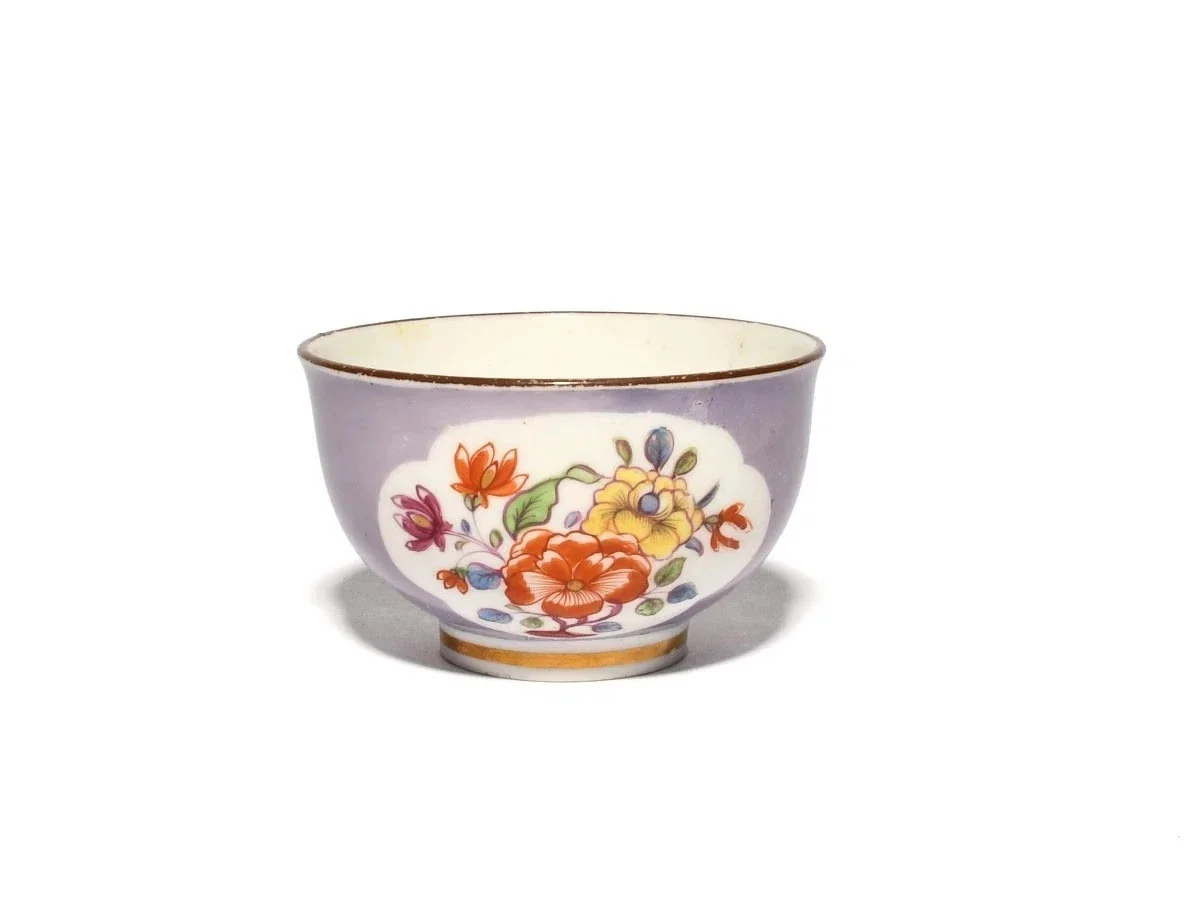




Lobed white reserves break across a soft lilac ground on this hard-paste porcelain tea bowl. Each shaped cartouche encloses hand-painted Indianische Blumen executed in an expanded Kakiemon palette of iron red, cobalt blue, yellow, purple, and green. These botanical sprays feature stylised chrysanthemum blooms, trailing stems, and delicate foliate tendrils framed cleanly against the bright white porcelain surface.
The interior well is finished in a smooth white glaze and decorated centrally with an isolated polychrome floral sprig that echoes the exterior enamels. Around the circular upper edge, a neat chocolate-brown rim line provides visual definition, contrasting with the pale ground below. A slender band of gilded lining encircles the raised footrim, accentuating the turned profile of the base.
Manufactured in Germany between 1730 and 1740, the bowl reflects the Meissen manufactory’s mastery of coloured ground coats alongside East Asian motifs. Without handles, as was customary for European tea bowls adapted from Asian prototypes during the early eighteenth century, the vessel was made specifically for sipping hot beverages. In size, the circular form measures 7.5 cm in width across the top rim.
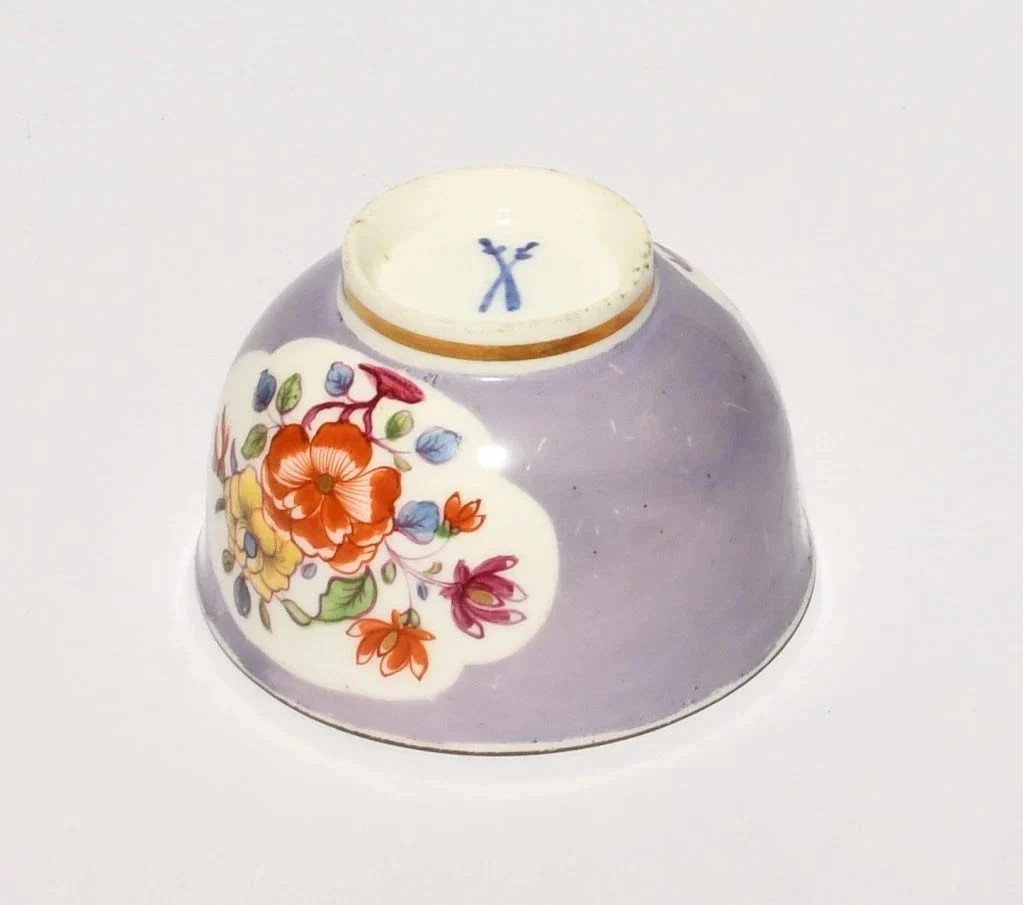
Underneath, the glazed recessed base bears the Meissen factory’s crossed swords mark painted by hand in underglaze blue. The potting demonstrates even wall thickness, uniform glaze coverage, and sharp articulation along the footrim, characteristic of Saxon factory output from the pre-1800 period. Subtle surface wear is present around the rim and footing in keeping with eighteenth-century domestic use, while the painted enamels retain their crisp definition.
Condition Minor age-related surface wear to the rim and footrim, with the polychrome enamel decoration and ground colour remaining intact.
Dimensions 7.5 cm wide
| Dimensions | 7.5 cm |
|---|---|
| Period | 18th Century |
| Style | Pre-1800 |
| Colour | Multicoloured |
| material | Porcelain |
| Origin | Germany |
| Maker | Meissen |
| Price range | Under £2000 |
| Collection Era | Antique & Vintage |
Only logged in customers who have purchased this product may leave a review.
Reviews
There are no reviews yet.