


Enquire Today!
If you have any questions, requests or general enquiries, please do not hesitate to email us and we will get back to you as soon as possible regarding your enquiry.
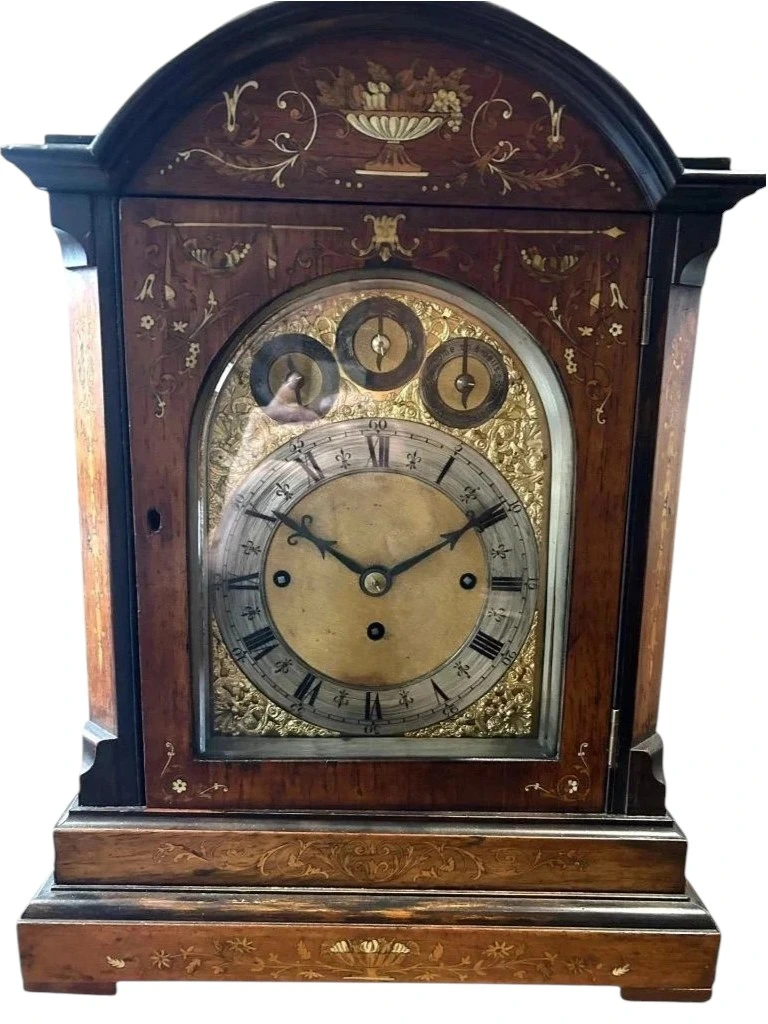


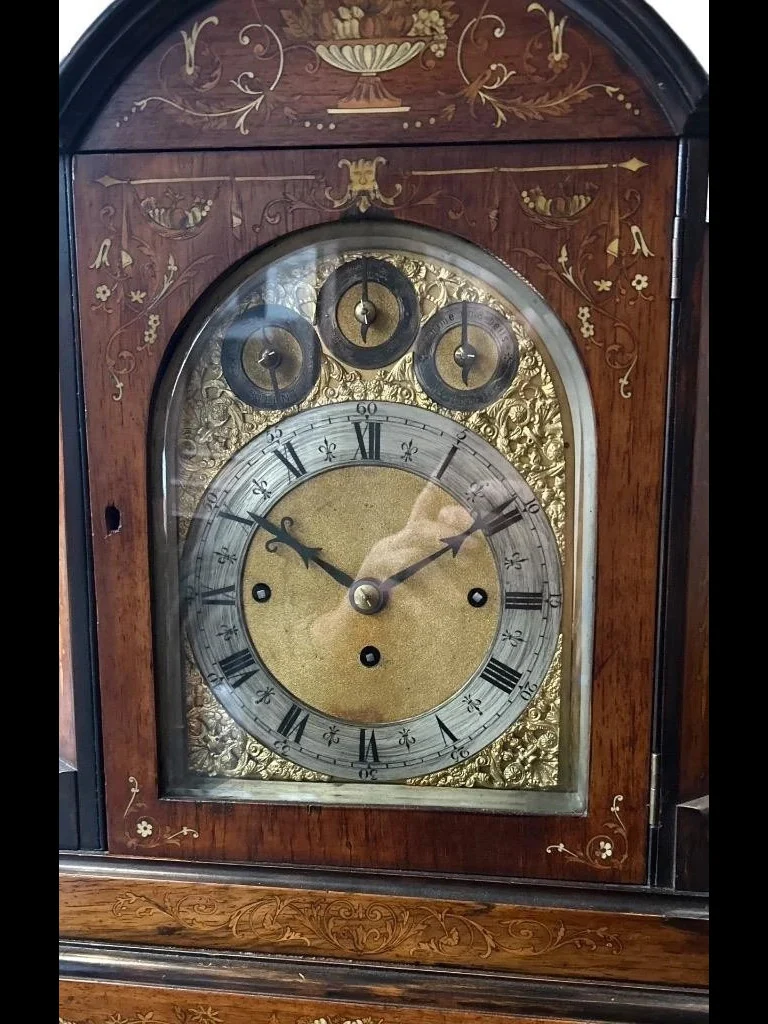
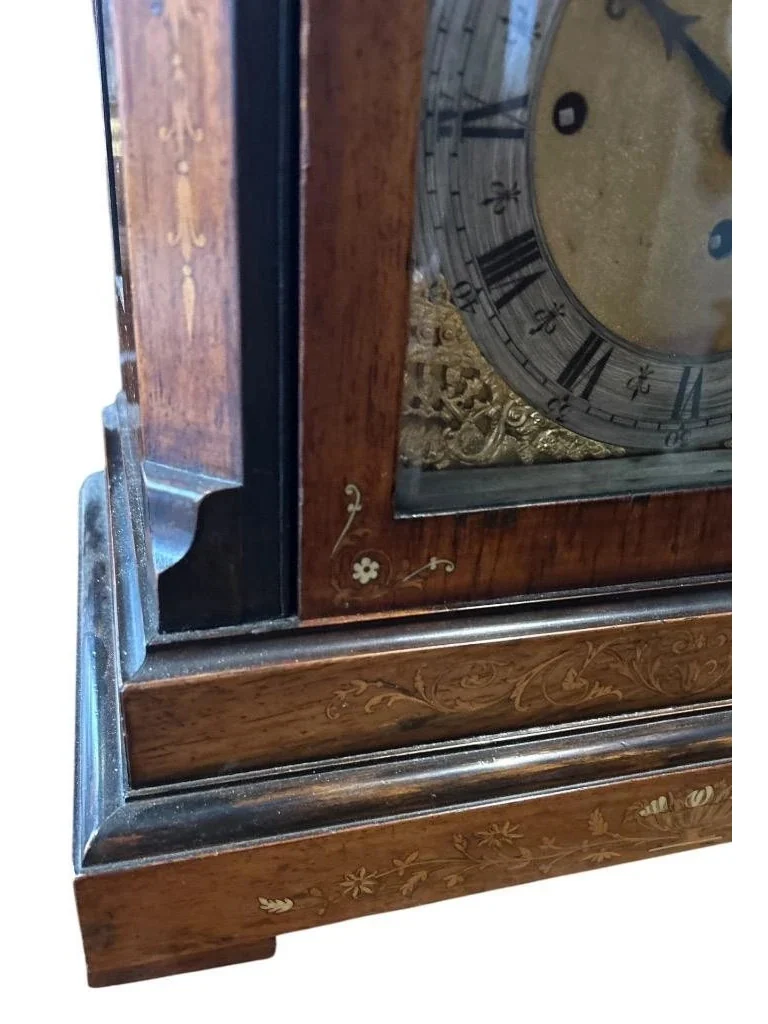




Elaborate marquetry inlays across the front and sides distinguish this late Victorian bracket clock, featuring classical urn motifs, floral sprays, trailing husks, and ribbon-tied swags set into warm mahogany veneers. The case is constructed with a pronounced arched pediment above ebonised mouldings, flanked by stepped plinths that rest upon an inlaid stepped base supported on low block feet. Both case flanks incorporate arched, pierced timber sound frets backed with fabric to allow the musical chimes to resonate clearly.
Behind the glazed front door sits an arched brass dial plate embellished with cast ormolu spandrels. The dial arrangement centres on a silvered chapter ring with Roman numerals and an outer minute track, flanked by three subsidiary dials in the arch for chime/silent selection, pendulum rise-and-fall regulation, and chime tune selection. Traditional pierced blued-steel hands complete the display.
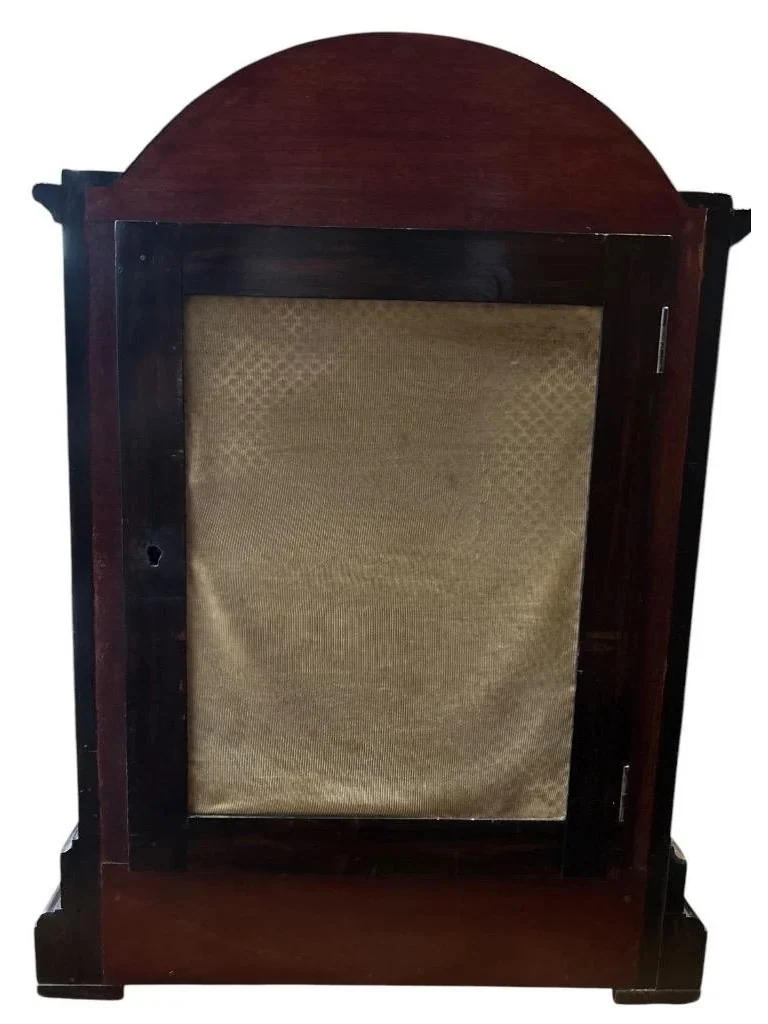
The movement is an English eight-day triple fusee mechanism operating chime, strike, and time trains, sounding on bells. Access to the movement is provided by the hinged rear door, fitted with an acoustic cloth panel to preserve sound projection while keeping dust out. The movement is reported to have been recently serviced and is accompanied by its pendulum and winding key.
Measuring 50.5 cm in height, 38 cm in width, and 25.5 cm in depth, this clock presents a substantial table or mantelpiece presence, dating to circa 1880.
Condition Presents in good antique condition with light surface wear, minor scuffs, and small marks to the timber consistent with age. Movement is reported to be in working order and recently serviced.
Dimensions 50.5 cm high x 38 cm wide x 25.5 cm deep
| Dimensions | 25.5 × 38 × 50.5 cm |
|---|---|
| Period | 19th Century |
| material | Brass, Mahogany, Steel, textile |
| Origin | England |
| Maker | Unbranded |
| Price range | £2000+ |
| Collection Era | Antique & Vintage |
| Style | Victorian |
| Colour | Brown, Gold, Silver |
Only logged in customers who have purchased this product may leave a review.
Reviews
There are no reviews yet.