


Enquire Today!
If you have any questions, requests or general enquiries, please do not hesitate to email us and we will get back to you as soon as possible regarding your enquiry.


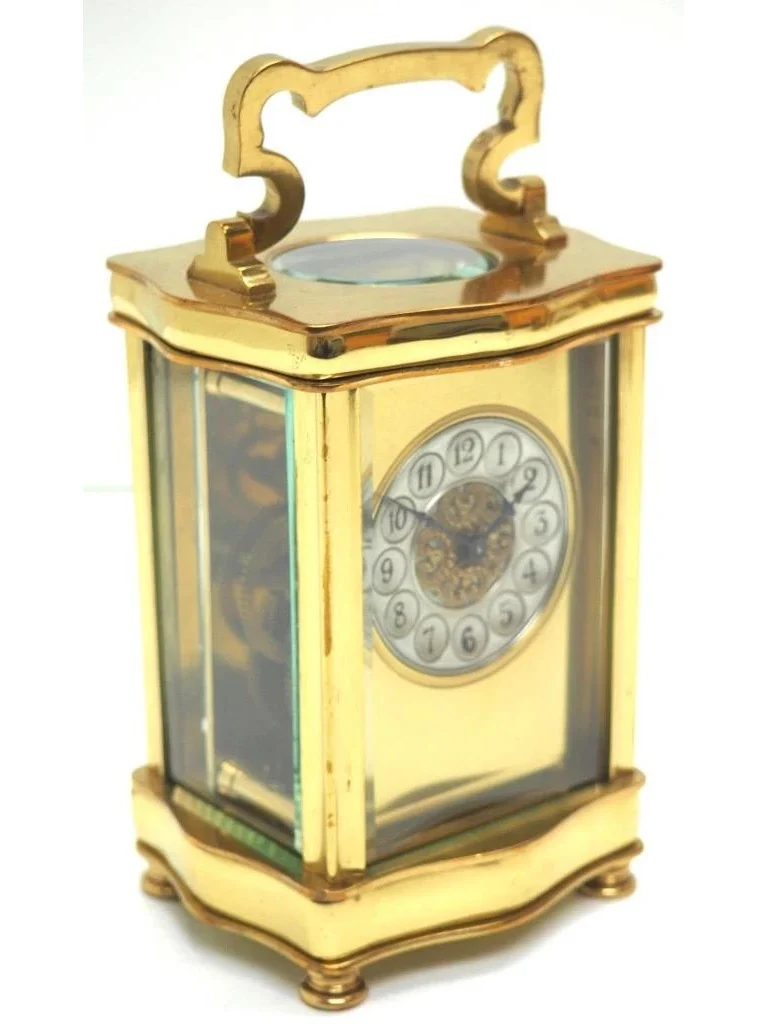
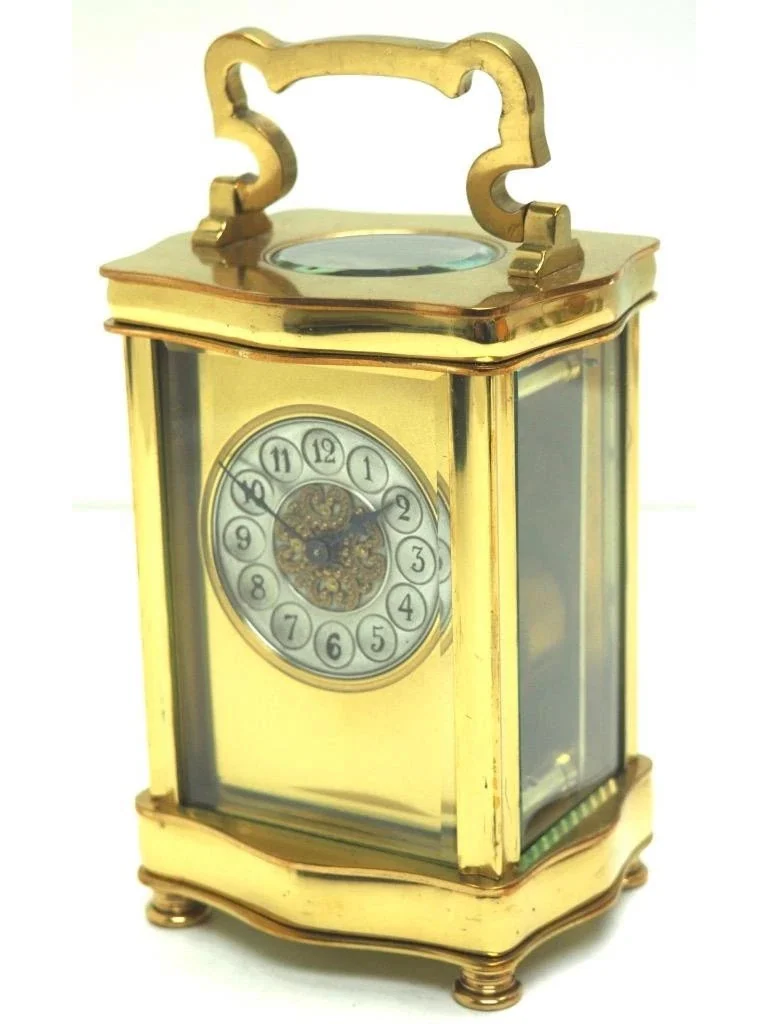


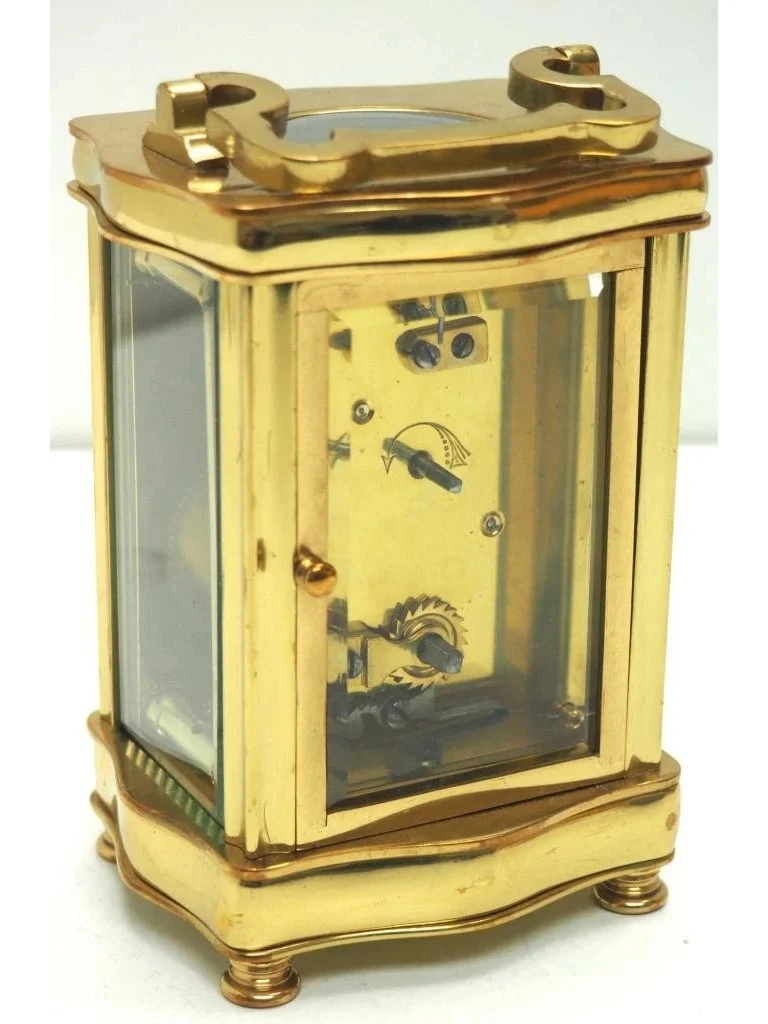


An undulating serpentine cornice and matching stepped plinth give this carriage clock its distinctive profile, departing from conventional rectangular case architecture. Cast in brass with a bright gilded finish, the case rests on four turned bun feet and is surmounted by a shapely cast handle. An oval bevelled glass aperture in the top panel allows clear observation of the balance wheel and escapement assembly.
The clock face presents a gilded mask surrounding a silvered chapter ring, decorated with Arabic numerals positioned inside individual circular roundels. At its heart, a detailed pierced floral rosette with granulated beadwork provides rich textural contrast against the blued steel hands. This circular arrangement sits flush within the gilded front mask, providing an elegant two-tone aesthetic.
Bevelled glass panels enclose the movement on all four sides, including the glazed rear door which opens to reveal the backplate, winding arbors, and hand-setting pivot. The clock measures 16 cm high with the handle raised, 9 cm in width, and 7.5 cm in depth. The interior houses an eight-day timepiece movement controlled by a lever platform escapement.
Manufactured in France around 1900, this clock survives in original condition with mild surface wear and age-related patina across the brass mouldings. The movement is reported to be in working order and retains its original balance mechanism, making it an attractive mantel or desk piece.
Condition Good overall condition consistent with age, showing light surface patina, minor marks to the brass case, and sound bevelled glass panels throughout. The eight-day movement is reported to be running and keeping time.
Dimensions Height 16 cm (handle raised), width 9 cm, depth 7.5 cm
| Dimensions | 7.5 × 9 × 16 cm |
|---|---|
| Period | 19th Century |
| Style | Edwardian |
| material | Brass, Glass, Steel |
| Origin | France |
| Price range | Under £2000 |
| Collection Era | Antique & Vintage |
| Colour | Gold, Silver |
| Maker | Unbranded |
Only logged in customers who have purchased this product may leave a review.
Reviews
There are no reviews yet.