


Enquire Today!
If you have any questions, requests or general enquiries, please do not hesitate to email us and we will get back to you as soon as possible regarding your enquiry.
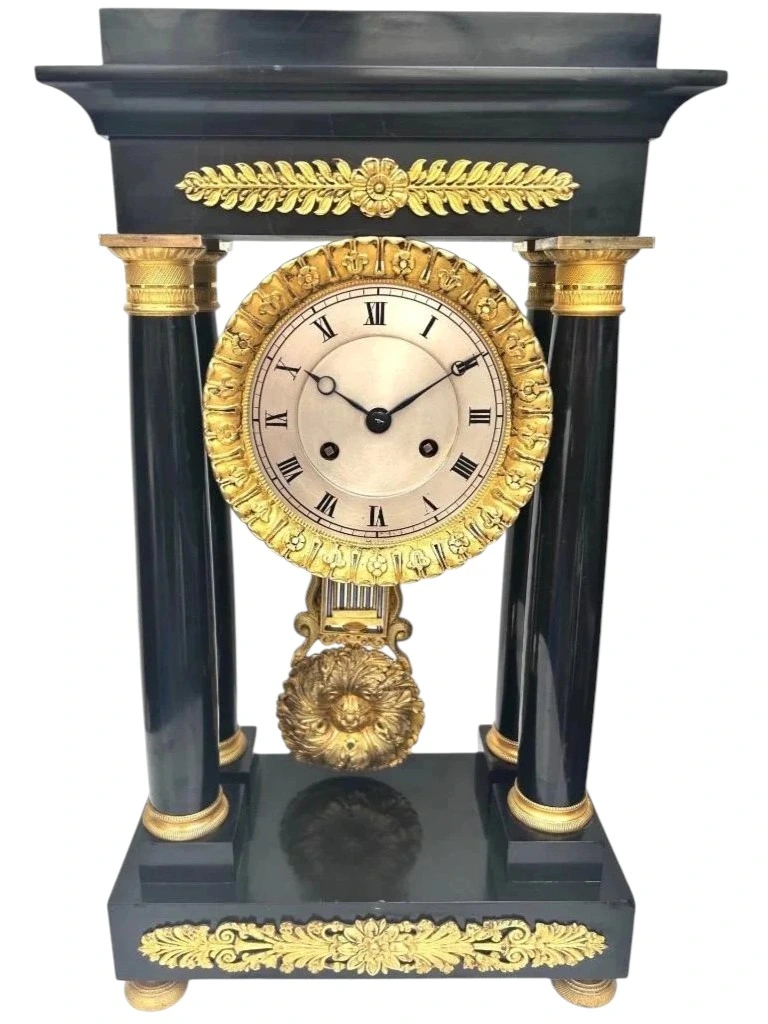

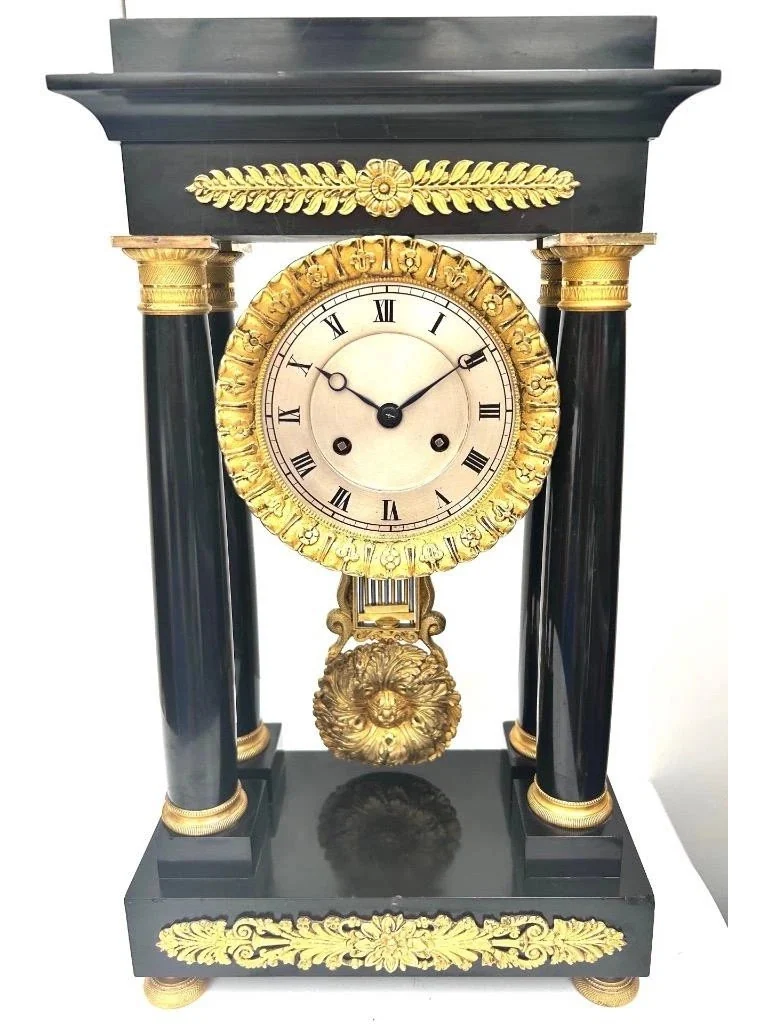
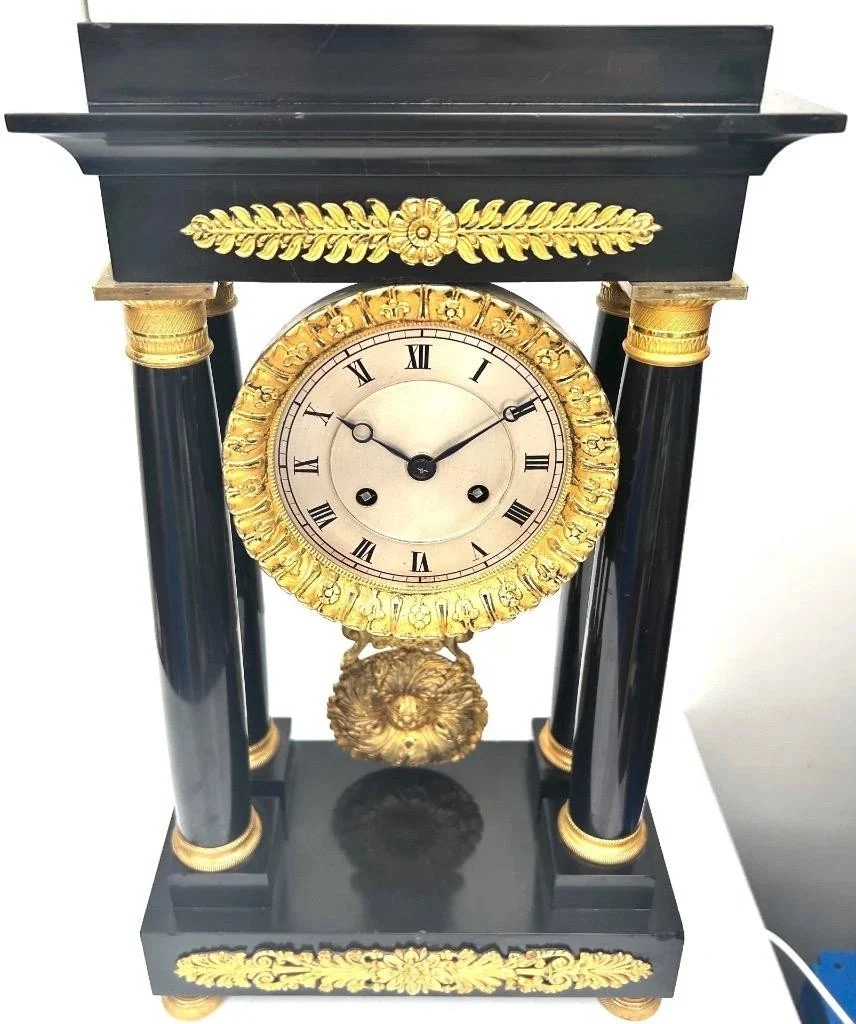
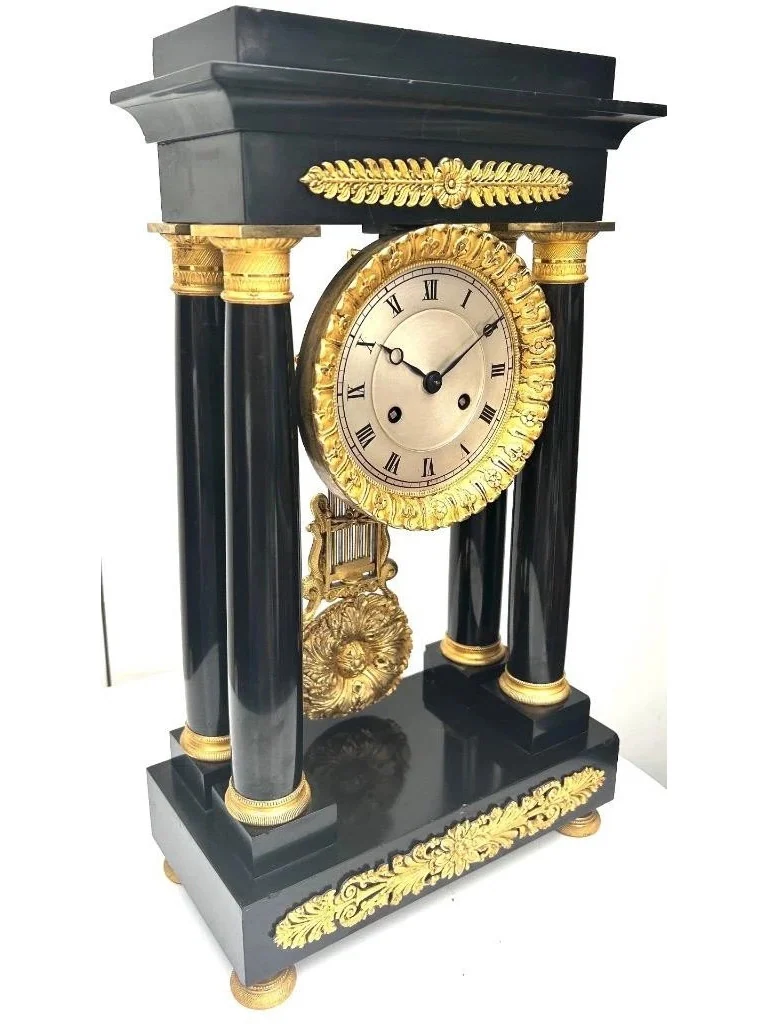


Four smooth cylindrical columns form the architectural framework of this French portico clock, supporting a stepped overhanging entablature above a substantial rectangular base. Both the upper frieze and the lower plinth display cast gilt-metal relief appliqués worked with foliate scrolls, acanthus leaves, and central rosettes. Finely detailed engine-turned capitals and moulded collar bases accent each upright, all supported on turned gilt feet.
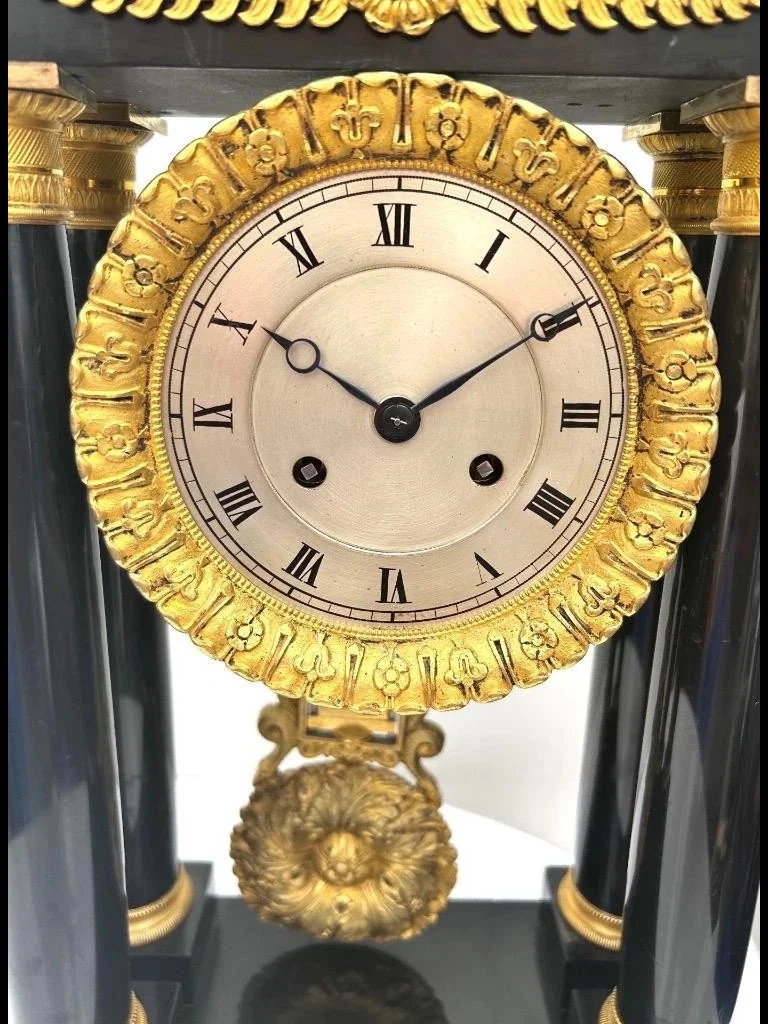
Positioned centrally within the portico, the circular dial features black Roman numerals and delicate Breguet-style blued hands against a silvered ground, with dual winding apertures. It is framed by a broad, gilded repoussé bezel decorated with a rhythmic sequence of embossed anthemia, rosettes, and scrolling foliage.
Swinging openly in the colonnade below, the pendulum displays an ornate embossed bob modelled with a radiant floral mask suspended from a decorative gridiron hanger. To the rear, the mechanical heart is an eight-day twin-train French brass movement engineered with skeletonised cut-out plates, designed to strike hours and half-hours on a bell, and reported to be in working order.
Originating in France circa 1860, the clock represents the restrained Neoclassical revival styling popular across Europe. While associated with the Paris clockmaker Le Roy, the dial signature is subdued beneath the bezel. The piece stands 44 cm high, 22 cm wide, and 12 cm deep, offering a balanced presence on a mantlepiece or credenza.
Condition Minor surface wear, light tarnishing to gilt brass mounts, and small edge abrasions consistent with age; movement reported to be in working order.
Dimensions 44 cm high x 22 cm wide x 12 cm deep
| Dimensions | 12 × 22 × 44 cm |
|---|---|
| Period | 19th Century |
| Style | French Empire Revival |
| Colour | Black, Gold |
| material | Brass, Ormolu, slate |
| Origin | France |
| Maker | Attributed to Le Roy |
| Price range | £2000+ |
| Collection Era | Antique & Vintage |
Only logged in customers who have purchased this product may leave a review.
Reviews
There are no reviews yet.