


Enquire Today!
If you have any questions, requests or general enquiries, please do not hesitate to email us and we will get back to you as soon as possible regarding your enquiry.


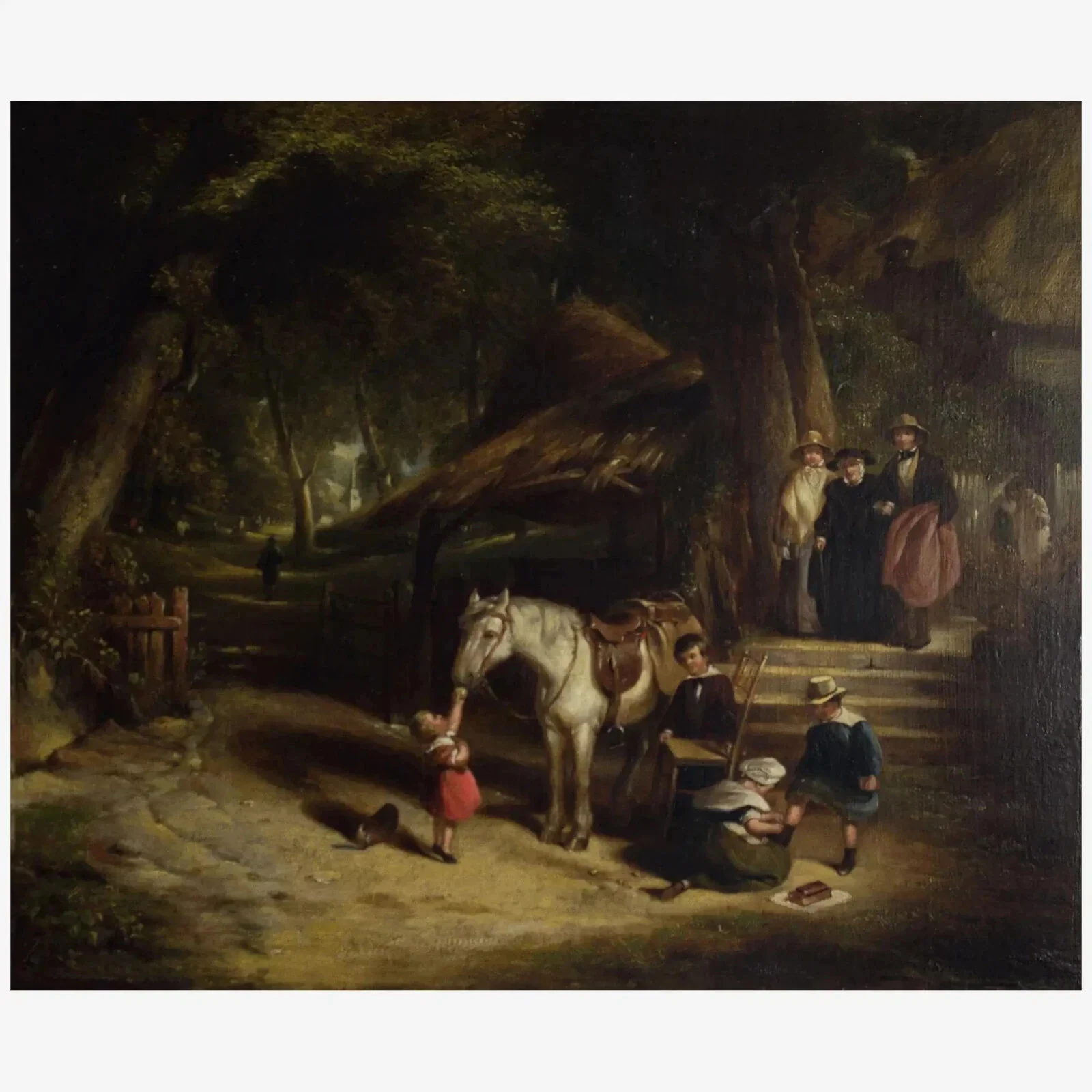

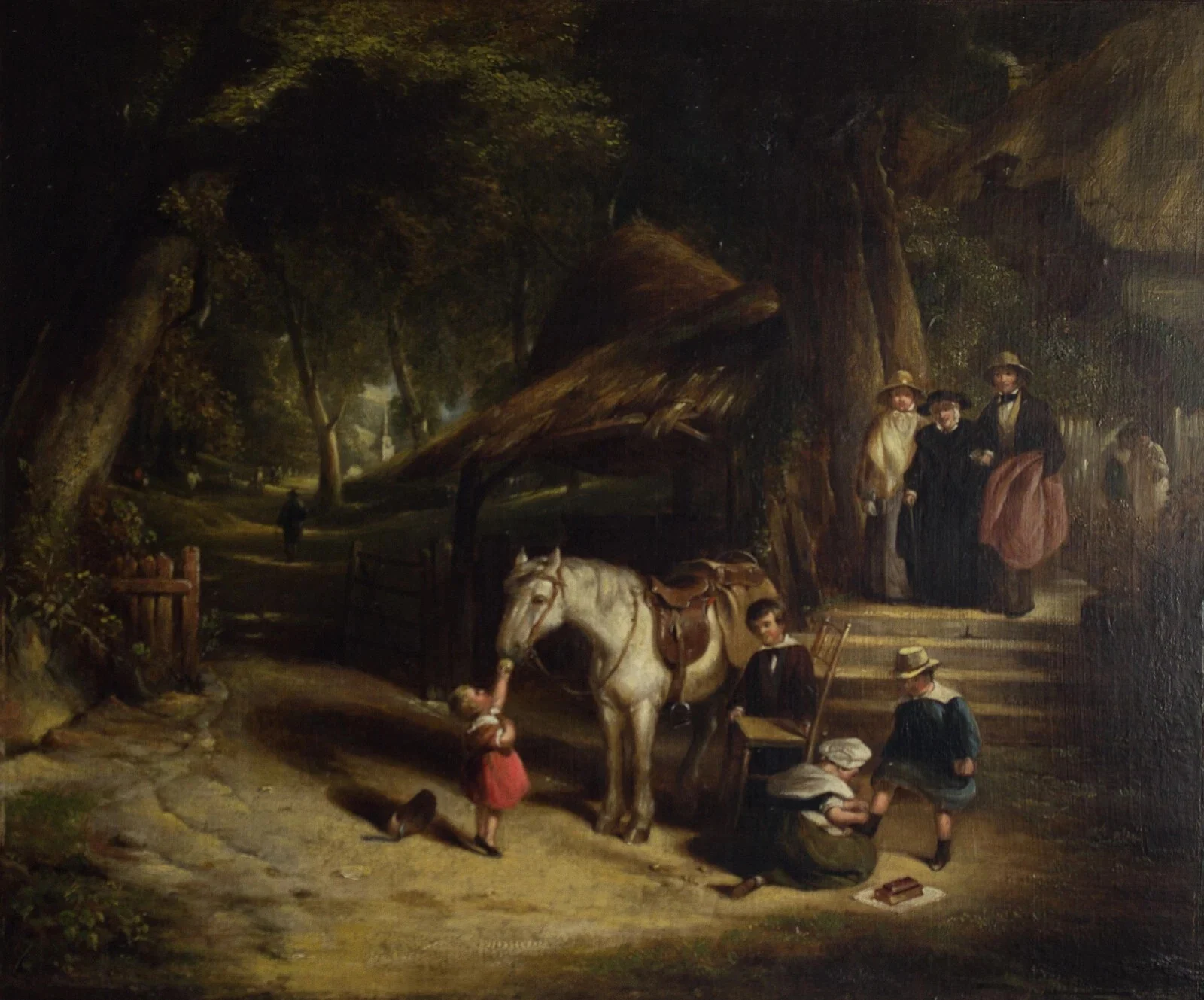


A quiet village gathering forms the heart of this nineteenth-century rural narrative, centering on an equipped saddled white pony surrounded by children and villagers outside a thatched outbuilding. To the left, a small child in red reaches up towards the horse’s muzzle, while nearby an attendant kneels to adjust a boy’s shoe beside an open prayer book resting upon the ground. An elder family group pauses on stone steps behind them, dressed in traditional Sunday best with coats, bonnets, and shawls, before a shadowed track receding towards a sunlit country church nestled in the distant woodland foliage. The composition employs rich earth pigments, dappled forest lighting, and careful rendering of country costumes and rustic timber structures.
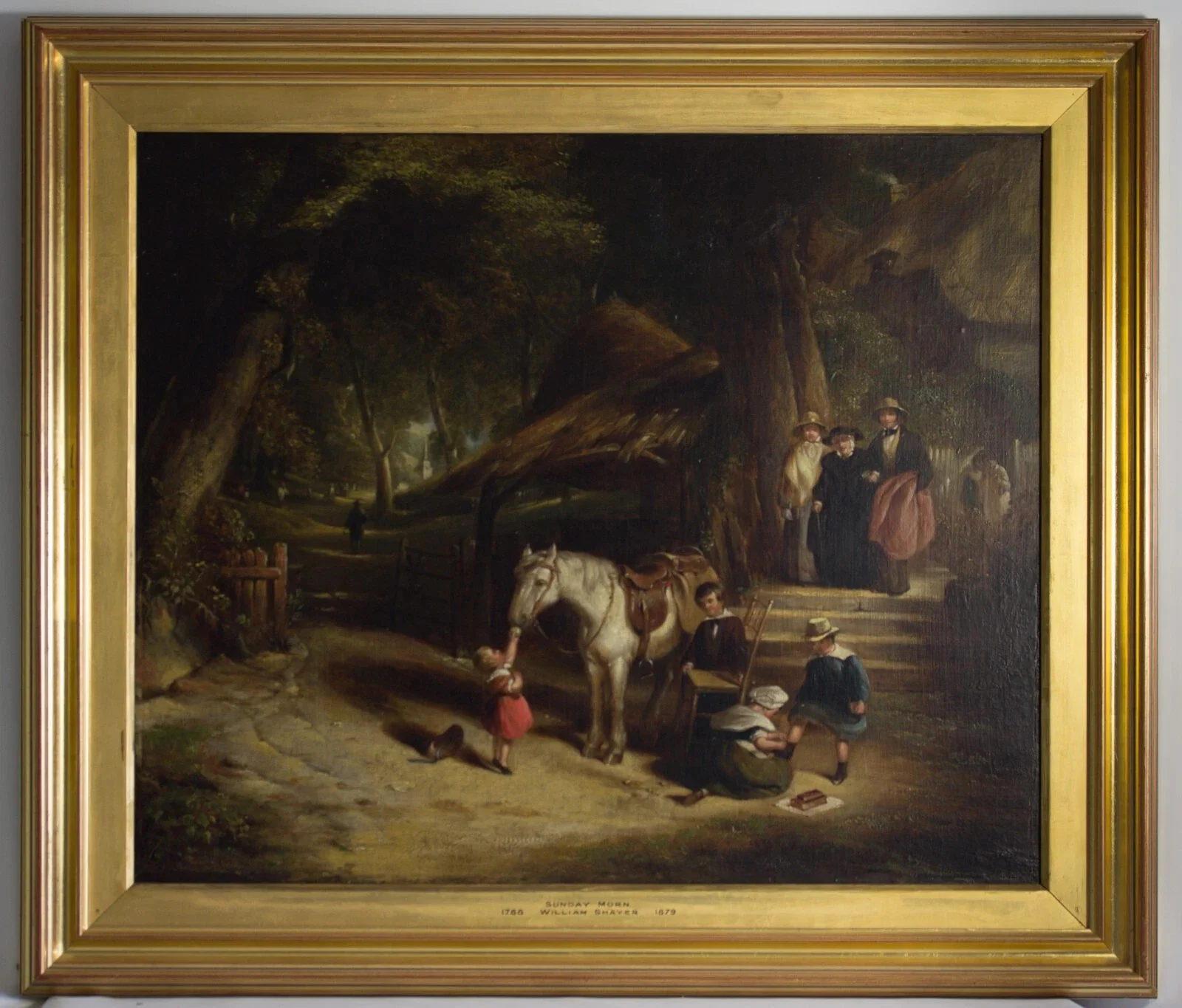
Measuring 62 cm by 75 cm within the sight edge and 81 cm by 94 cm framed, the work is executed in oil on canvas and is apparently unsigned. It is housed in a later molded giltwood frame fitted with a lower title tablet attributing the work to William Shayer. Family collaboration was a standard aspect of the Shayer household practice, where the elder painter worked alongside four artist sons who shared his rustic genre subjects: William Joseph Shayer, Charles Waller Shayer, Henry Thring Shayer, and Edward Dasherwood Shayer. The elder Shayer also regularly collaborated with landscape painter Edward Charles Williams, painting figures and livestock into Williams’s country settings. While the deep woodland roadway and pastoral staging strongly reflect the elder master’s hand, familial assistance remains a recognized characteristic of works from this Hampshire circle.
About the Artist:
William Shayer the Elder (British, 1787–1879) commenced his working life in Southampton decorating furniture before taking up coach painting in Guildford. His skill in heraldic painting brought commissions including the Earl of Richmond’s funeral escutcheon. While visiting Southampton, he studied under marine painter Jock Wilson before devoting himself to naturalistic landscape and genre painting across Hampshire, the New Forest, and Devon. Shayer became celebrated for bustling depictions of rural labourers, gypsies, fishermen, and pastoral drovers.
Working from 26 Grafton Street in Soho, Shayer built an extensive exhibition career in London. Between 1825 and 1870 he showed 338 paintings at the Society of British Artists, receiving full membership in 1862. He also contributed 82 works to the British Institution between 1827 and 1862, alongside six canvases at the Royal Academy between 1820 and 1843. Today his paintings are preserved in major public collections including the Tate, the Victoria and Albert Museum, the Metropolitan Museum of Art in New York, the Montreal Museum of Fine Arts, and regional art galleries in Glasgow, Leicester, Salford, and Sunderland. Shayer died at Bladon Lodge in Southampton in 1879.
Details:
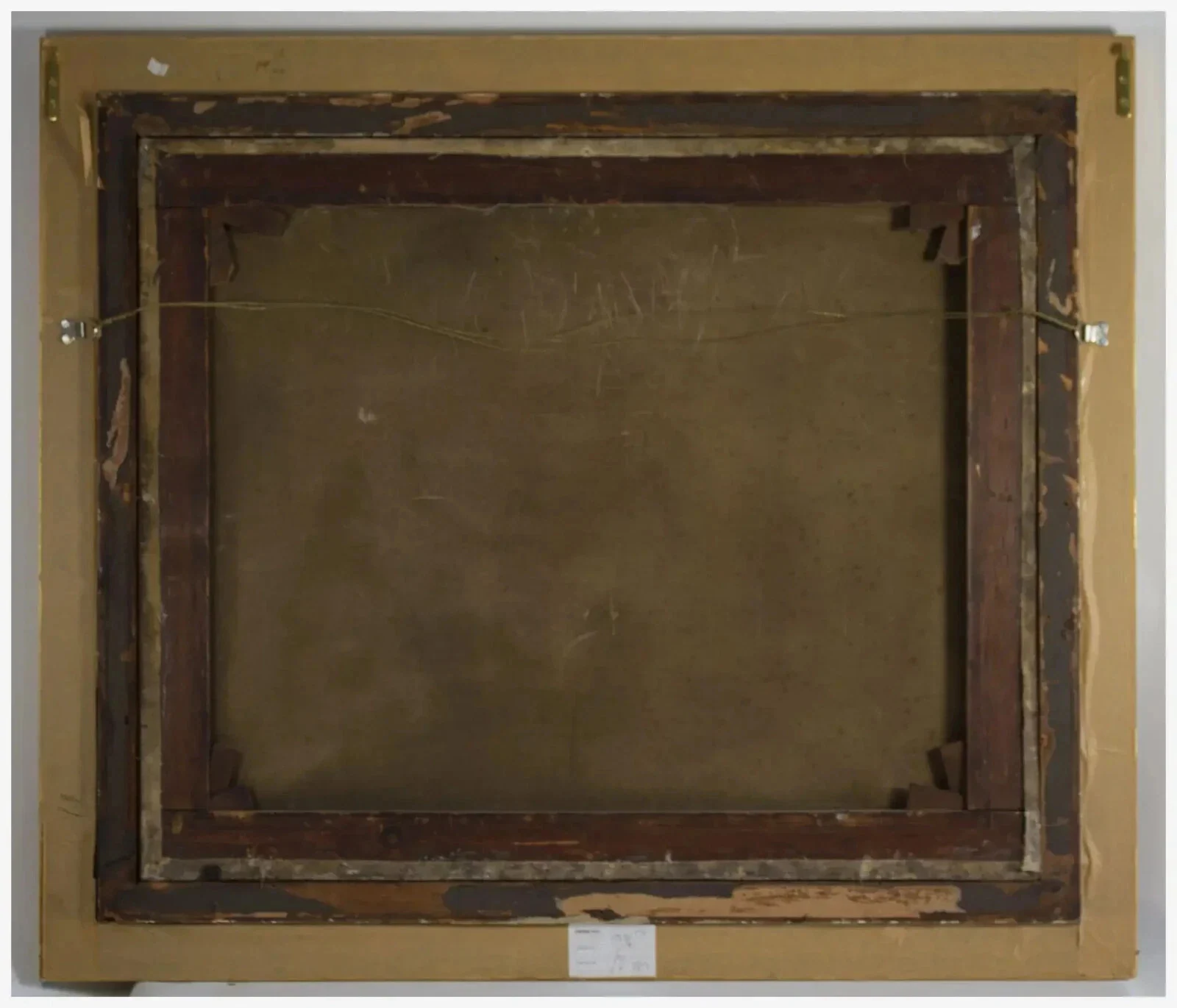
The canvas measures 62 cm wide by 75 cm high, and the overall framed dimensions are 81 cm wide by 94 cm high. The painting has been professionally lined and secured into a substantial later giltwood frame fitted with hanging wire on the reverse.
Condition The canvas has been lined and is clean and stable. Ultraviolet examination reveals areas of retouching primarily situated along the upper edge. The later giltwood frame shows minor age-appropriate wear and remains structurally sound.
Dimensions Sight: 62 cm x 75 cm; Frame: 81 cm x 94 cm
| Dimensions | 62 × 75 cm |
|---|---|
| Period | 19th Century |
| Style | Victorian |
| Colour | Brown, Cream, Green, Red, White |
| material | Oil on canvas |
| Origin | England |
| Maker | Attributed to William Shayer |
| Price range | £2000+ |
| Collection Era | Antique & Vintage |
Only logged in customers who have purchased this product may leave a review.
Reviews
There are no reviews yet.