


Enquire Today!
If you have any questions, requests or general enquiries, please do not hesitate to email us and we will get back to you as soon as possible regarding your enquiry.

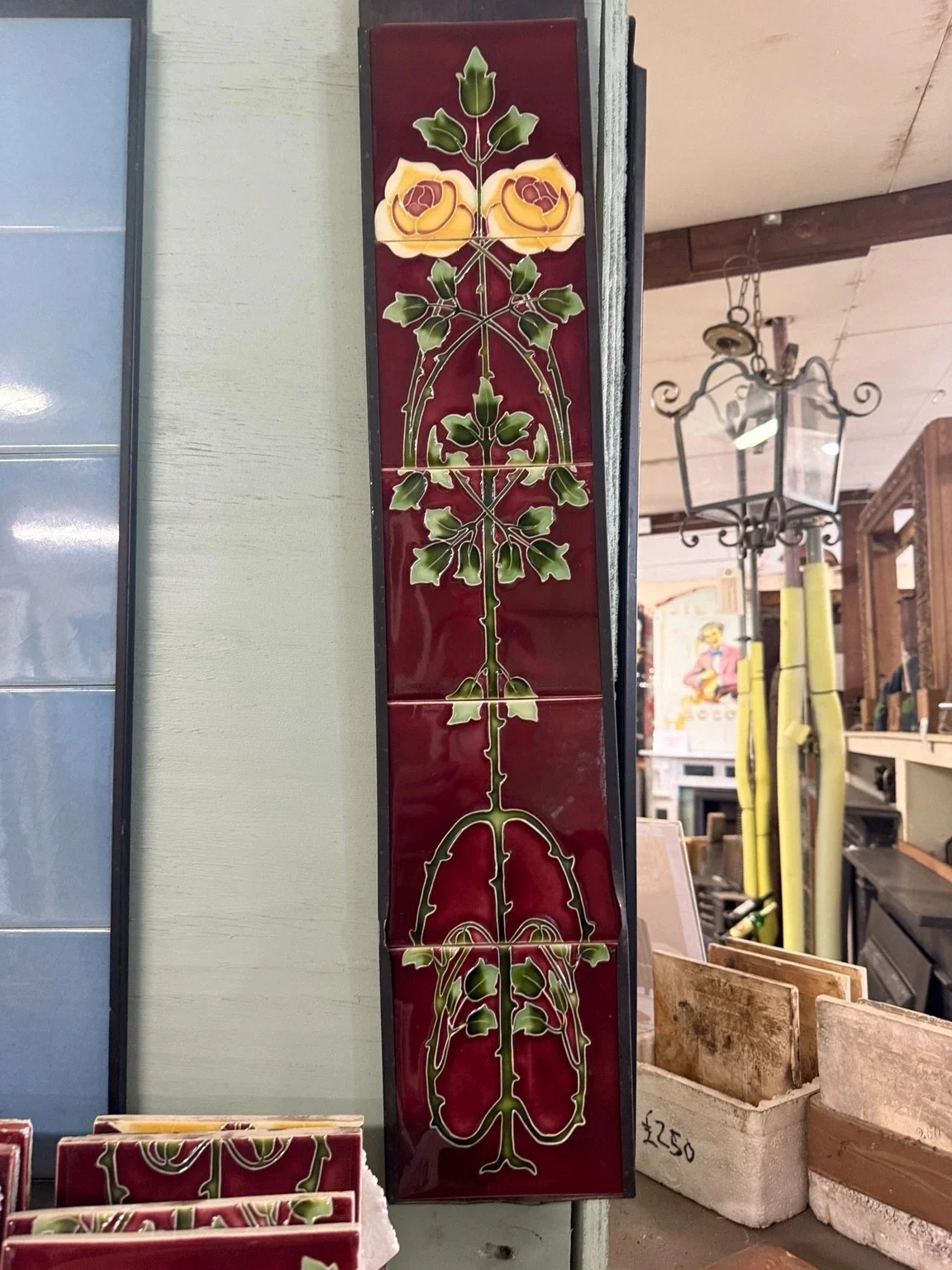


Twin pale yellow rose heads crown an elongated, sinuous briar stem flanked by stylized foliage, executed in raised slip-trailed tubelining against a deep, lustrous burgundy ground glaze. The floral motif typifies the Art Nouveau style, combining organic naturalism with rhythmic whiplash lines that flow vertically down the entire composition. The continuous design spans a vertical five-tile column, standard for period cast iron fireplace cheeks. Each ceramic tile connects precisely with the adjoining sections, carrying the central thorny stem from the twin yellow blooms through alternating leaf clusters down into an arched, root-like foliate base. Tubelining was carried out by piping liquid clay slip onto the unfired tile bodies to create raised dividing ridges, functioning much like cloisonne wire. Translucent coloured glazes were then pooled within each compartment, allowing rich, graduated shading on the petals and leaves while keeping the crisp claret background flat and glossy. The high-sheen lead glaze lends notable depth to the wine-red surface. Dating to around 1905, tiles of this pattern were made in major English pottery centres such as Staffordshire for Edwardian and late Victorian tiled fireplace inserts. Matching five-tile sets frequently suffered breakages when grates were removed during renovations, so retaining the complete upright run intact is advantageous for authentic architectural restorations. The tiles remain in good reclaimed condition, showing faint age-related glaze crazing, minor kiln specks, and slight edge nibbles consistent with salvage and mortar removal, with no heavy losses to the central decorative surface.
Condition Good reclaimed condition with fine glaze crazing, light edge nibbles, and minor firing imperfections consistent with architectural salvage.
Dimensions Approximately 76 cm x 15 cm overall (five 6 x 6 inch tiles)
| Period | 20th Century |
|---|---|
| material | Earthenware, glaze |
| Origin | England |
| Price range | Under £1000, Under £2000, Under £500 |
| Collection Era | Antique & Vintage |
| Style | Art Nouveau |
| Colour | Green, Red, Yellow |
Only logged in customers who have purchased this product may leave a review.
Reviews
There are no reviews yet.