


Enquire Today!
If you have any questions, requests or general enquiries, please do not hesitate to email us and we will get back to you as soon as possible regarding your enquiry.
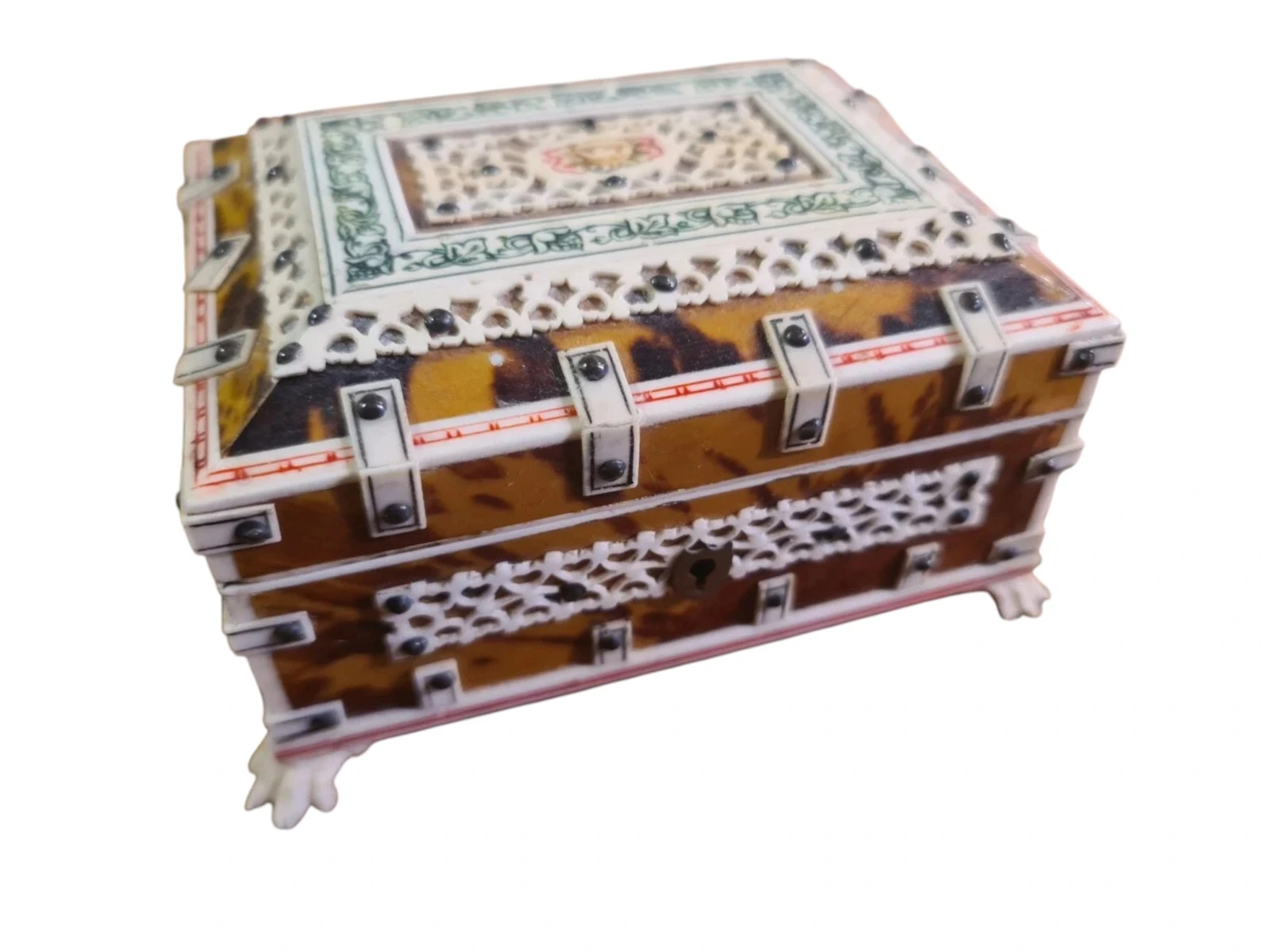
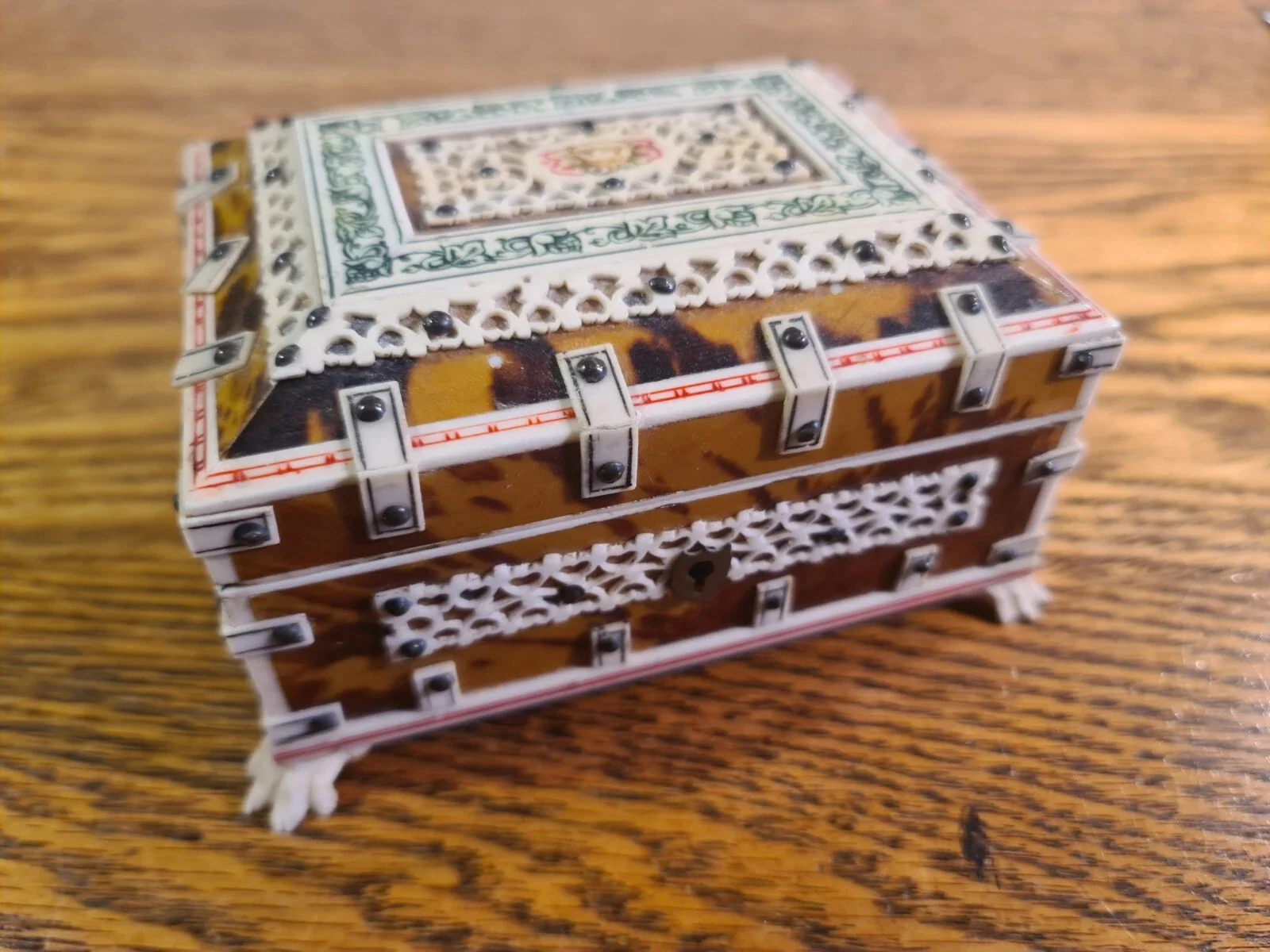


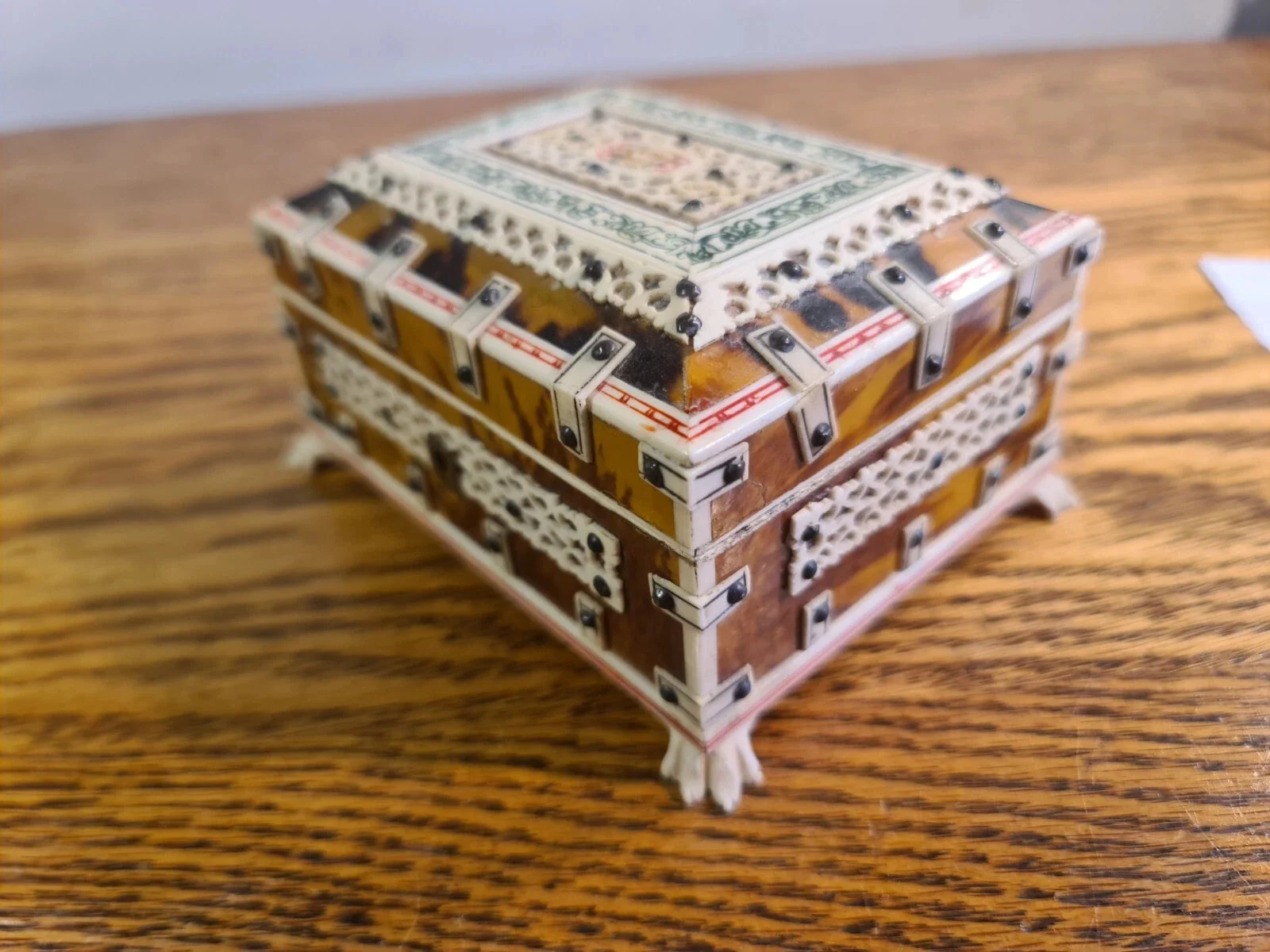


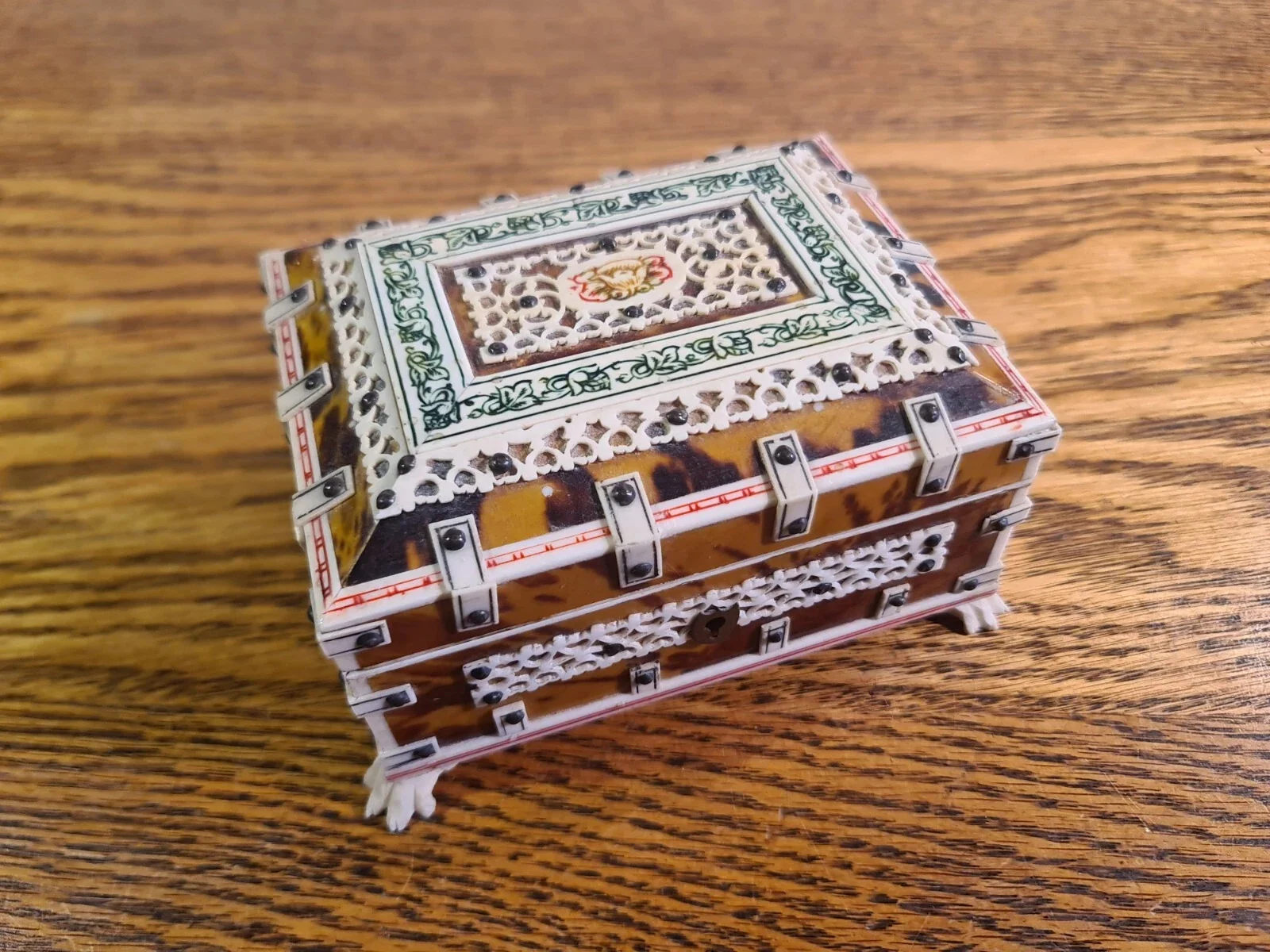


Mottled tortoiseshell veneer cloaks the exterior of this Anglo-Indian casket, which is fashioned in a traditional sarcophagus form with a raised, stepped lid and supported on four carved animal paw feet. The sloping lid profiles and lower carcass are framed by applied borders of polished bone, detailed with linear incised red lac banding. Vertical strapped corner brackets and reinforcing strips run up the sides and over the bevelled edges, each anchored in place by tiny dark rounded pins that lend a distinct chest-like appearance to the miniature structure.
Intricate fretwork overlays dominate the decorative scheme across the top and sides. The central panel on the lid features a delicate openwork geometric lattice accented with small dark studs and surrounded by an engraved penwork border displaying flowing foliate scrolls filled with dark green pigment. At the centre of this upper fretwork panel sits a circular cartouche highlighted with red and ochre pigment depicting an open flowerhead. Beneath this panel, continuous pierced openwork friezes wrap around the coved edges of the lid and the front apron, mirroring the architectural fretwork characteristic of regional Indian craftsmanship.
Produced in the Coromandel Coast port of Visakhapatnam around 1895, this dressing box exemplifies the export luxury wares created for European residents and travellers during the late Victorian era. Local workshops specialised in combining indigenous and imported natural materials, layering pierced bone, tortoiseshell, and exotic timbers over a sturdy sandalwood or teak core. The contrast between the warm amber translucency of the tortoiseshell and the pale openwork fretwork produces a rich, luminous surface texture.
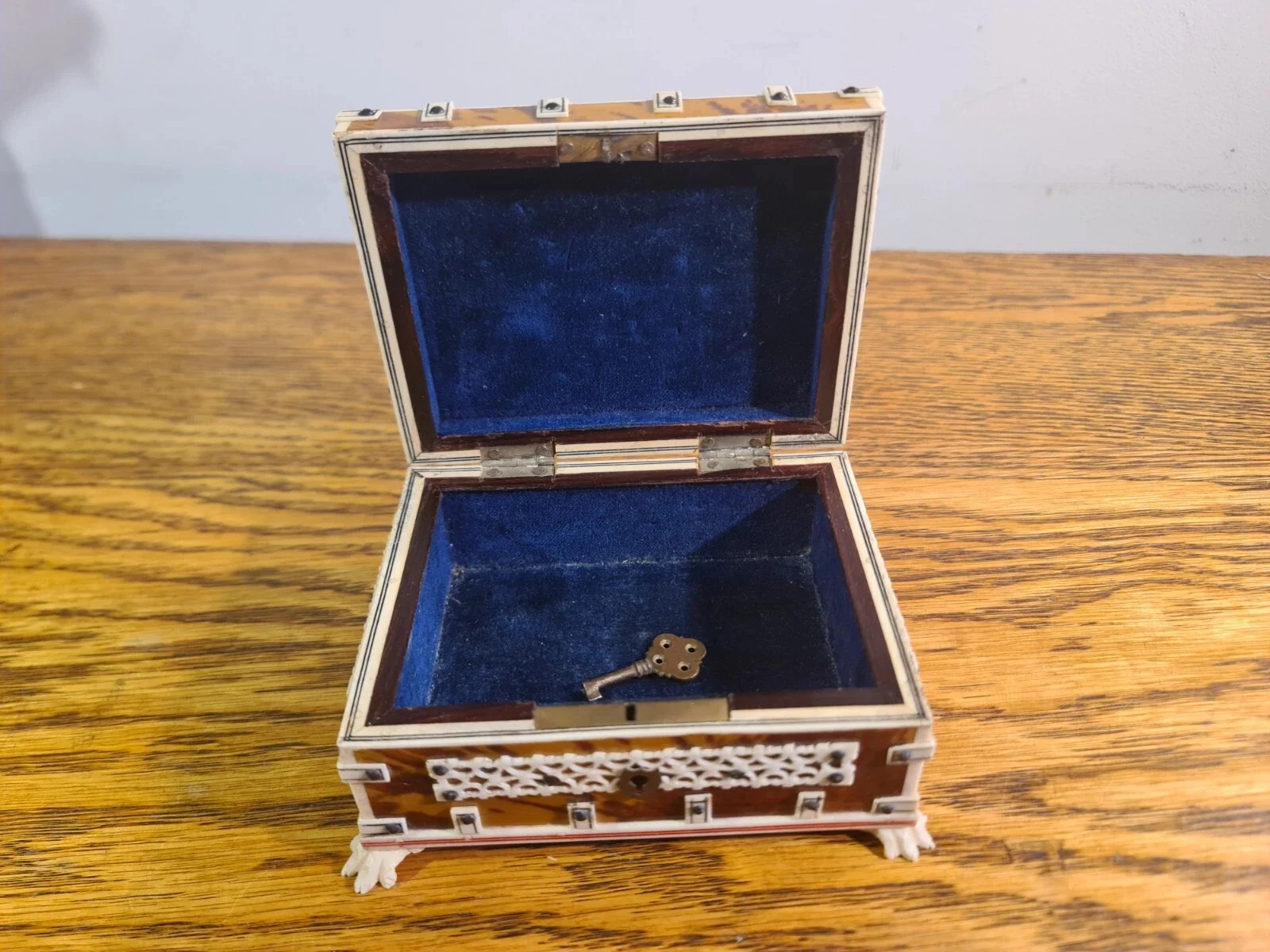
The hinged lid lifts smoothly on brass hinges to reveal an interior lined in deep cobalt-blue velvet, providing a soft storage space suitable for jewellery, keepsakes, or small dressing items. The internal rim is neatly finished with matching striped bone lining around the lock keep. Fitted with its original brass lockplate, the box comes accompanied by its small decorative four-hole brass key, which is reported to be in working order. The piece measures approximately 13.0 cm in width by 10.0 cm in depth, standing 6.0 cm high.
Condition The casket remains structurally sound and well preserved, with fretwork overlays, applied straps, and carved paw feet intact. Minor surface wear and faint natural drying lines consistent with antique tortoiseshell and bone wares. The blue velvet lining is clean, and the lock mechanism with its accompanying key is reported to be working.
Dimensions 13.0 cm x 10.0 cm x 6.0 cm
| Dimensions | 10 × 13 × 6 cm |
|---|---|
| Period | 19th Century |
| material | bone, Brass, tortoiseshell, velvet, Wood |
| Origin | India |
| Price range | Under £1000, Under £2000 |
| Collection Era | Antique & Vintage |
| Style | Late Victorian |
| Colour | Blue, Brown, Cream |
Only logged in customers who have purchased this product may leave a review.
Reviews
There are no reviews yet.