


Enquire Today!
If you have any questions, requests or general enquiries, please do not hesitate to email us and we will get back to you as soon as possible regarding your enquiry.
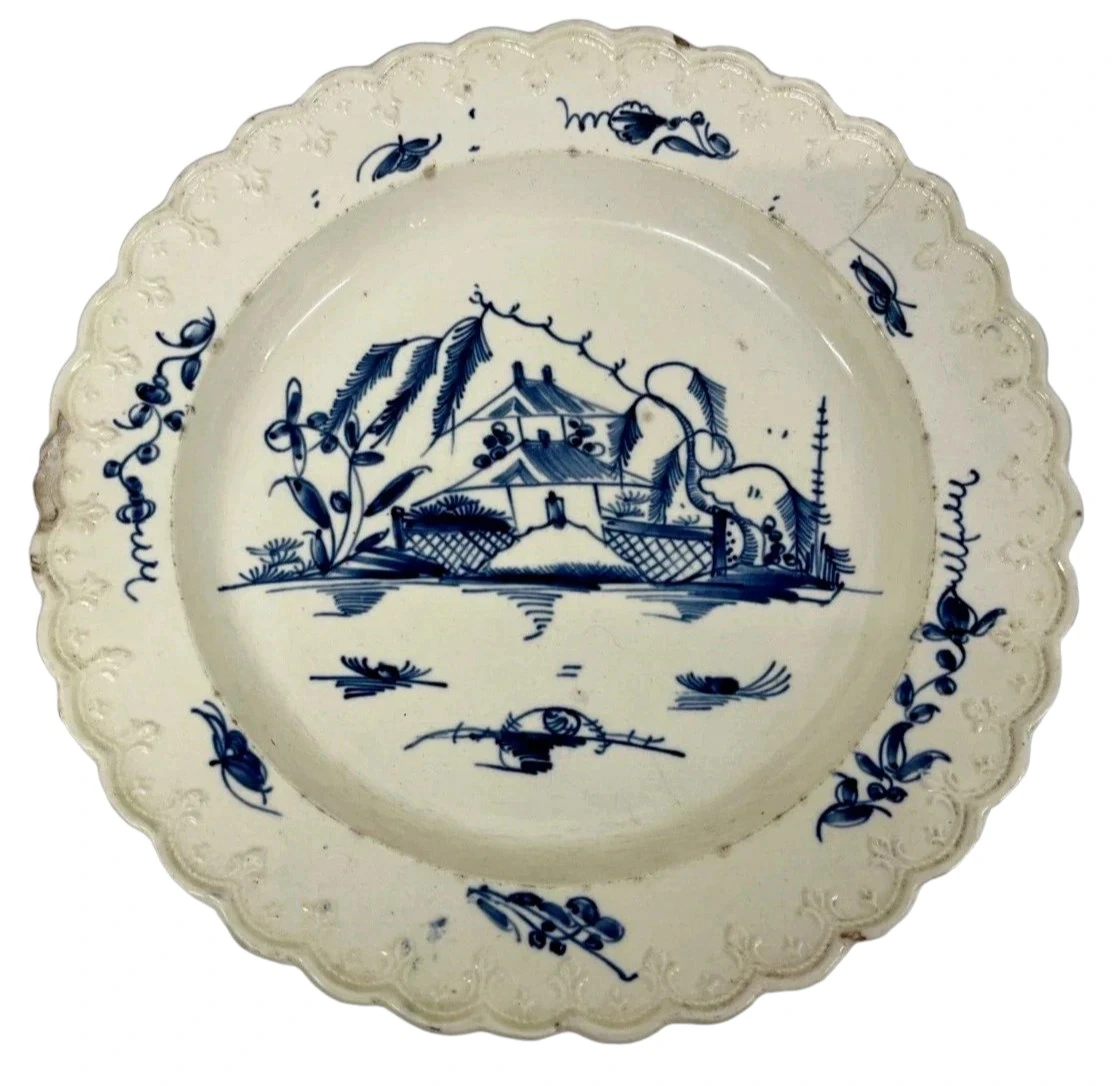


A pagoda structure flanked by a lattice fence, trailing willow foliage, and quiet waters forms the centrepiece of this English earthenware plate. Rendered by hand in underglaze cobalt blue, the mock Oriental scene reflects period European enthusiasm for Chinese export porcelain, capturing architectural forms alongside stylised riverside trees, floating vegetation, and small foreground islands. Surrounding the circular well, the broad rim displays a scalloped border enriched with moulded foliate scrolls in low relief. This decorative edging is interspersed with freely painted blue floral sprigs and curling fronds, creating a balanced frame that contrasts against the pale background glaze. Attributed to Liverpool potteries and produced circa 1750, the dish illustrates early British attempts to emulate imported blue-and-white porcelain on an earthenware body. The transparent lead glaze poolings exhibit a soft bluish-green tint in the crevices of the relief moulding and around the foot rim, a hallmark of early pearlware and creamware experimentation. The reverse is undecorated, featuring an integral foot rim and a slightly uneven hand-thrown contour. Visible potting characteristics include tiny kiln pin-pricks and small clay inclusions beneath the glossy glaze, giving the underside an authentic tactile finish. Measuring 24 cm in diameter and weighing 332 grams, the plate survives in fair antique order. Preservation shows expected edge fritting, minor glaze abrasions, and a fine hairline extending from the rim seen on the rear, reflecting its domestic history.
Condition Minor fritting and small chips to the rim, accompanied by a hairline crack visible on the reverse and light glaze wear.
Dimensions 24 cm diameter
| Weight | 0.332 kg |
|---|---|
| Dimensions | 24 × 24 cm |
| Period | 18th Century |
| Colour | Blue, White |
| material | Earthenware |
| Origin | England |
| Price range | Under £1000, Under £2000, Under £500 |
| Collection Era | Antique & Vintage |
| Style | Georgian |
| Maker | Liverpool |
Only logged in customers who have purchased this product may leave a review.
Reviews
There are no reviews yet.