


Enquire Today!
If you have any questions, requests or general enquiries, please do not hesitate to email us and we will get back to you as soon as possible regarding your enquiry.

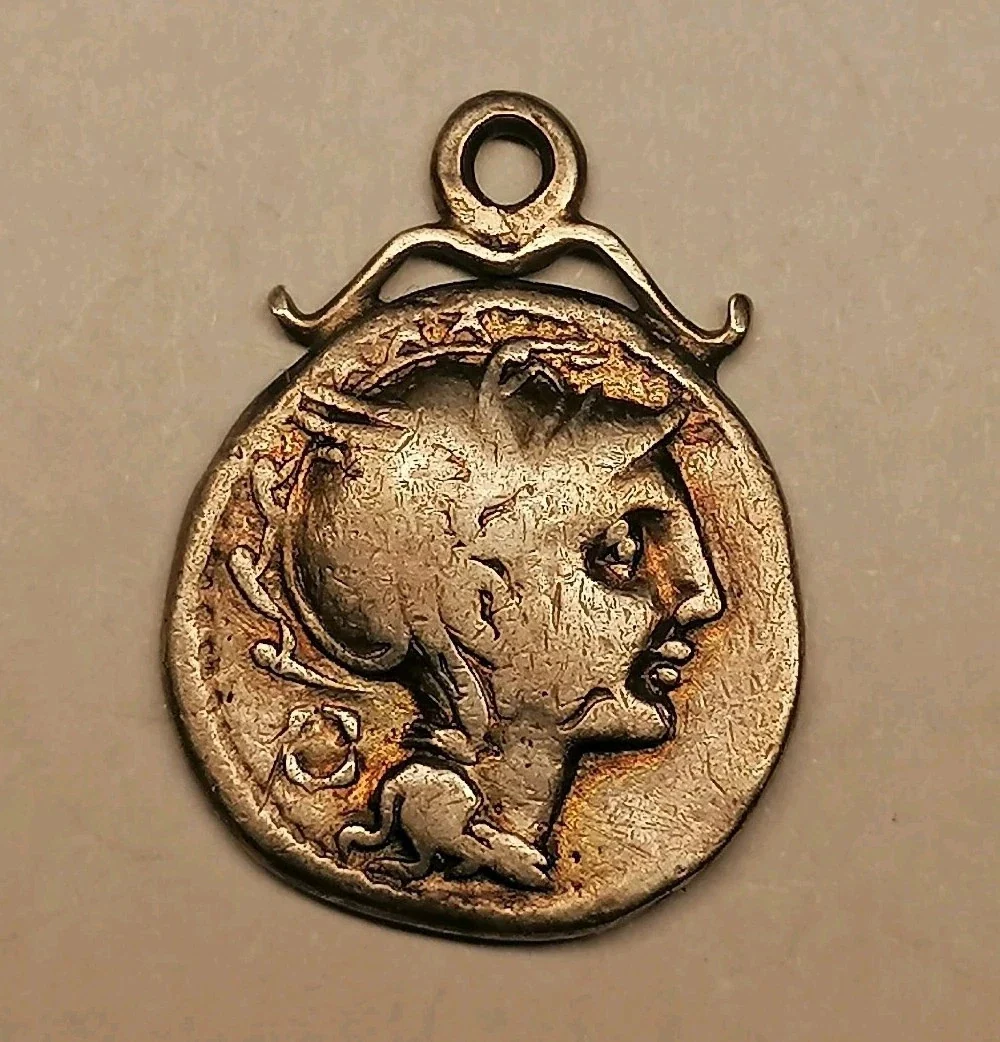
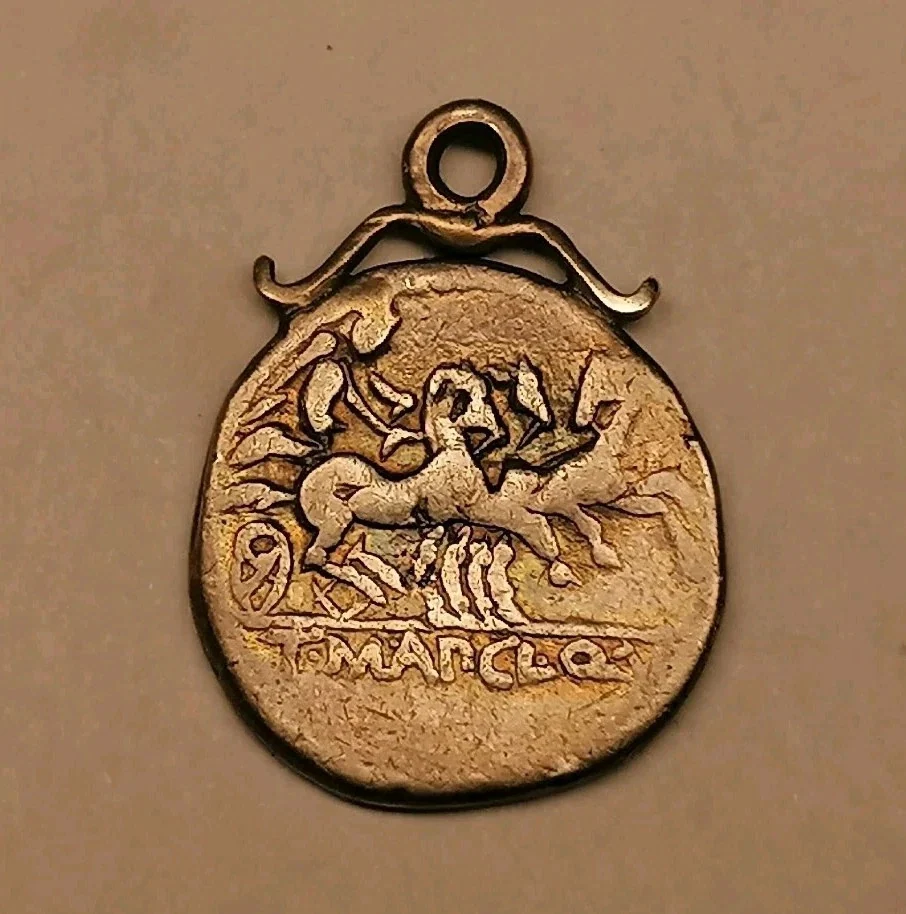


Hand-struck in silver with an irregular flan, this pendant centres on an ancient coin fitted with a soldered curved suspension bail at the top rim. The obverse depicts the right-facing profile of Roma wearing a winged helmet, flanked by a modest device behind the neck and framed by residual beaded border details along the perimeter. The reverse illustrates a spirited triga, or three-horse chariot, driven at speed towards the right. Below the ground line, the exergue carries the abbreviated moneyer inscription associated with the triumvirs Appius Claudius Pulcher, Titus Mallius, and Quintus Urbinius. The depiction of a three-horse chariot is particularly distinctive within Republican numismatics, where bigae and quadrigae appear far more frequently. Struck in Rome around 111–110 BC and catalogued under Crawford reference RRC 299/1b, this silver denarius exemplifies late Republican coinage produced by the state mint. At some stage after its circulating life, the piece was transformed into jewellery through the addition of a contoured wire loop, enabling it to be suspended from a neck chain or cord. The coin displays smooth surface wear to the high points of the helmet and horses, consistent with prolonged ancient circulation, along with natural metallic toning settled into the crevices of the design. The flan measures approximately 16.8 mm in diameter with a thickness of 1.8 mm, and the complete mounted pendant weighs 3.97 grams.
Condition Soldered suspension loop attached to the upper edge for wear. Typical softening and honest wear to high points from circulation, with attractive natural toning across the recesses.
Dimensions 1.68 cm diameter, 0.18 cm depth; weight 3.97 g
| Weight | 0.00397 kg |
|---|---|
| Dimensions | 1.68 × 1.68 cm |
| Period | Unknown |
| Colour | Silver |
| material | Silver |
| Origin | Italy |
| Price range | Under £1000, Under £2000 |
| Style | Roman Republic |
Only logged in customers who have purchased this product may leave a review.


Reviews
There are no reviews yet.