


Enquire Today!
If you have any questions, requests or general enquiries, please do not hesitate to email us and we will get back to you as soon as possible regarding your enquiry.

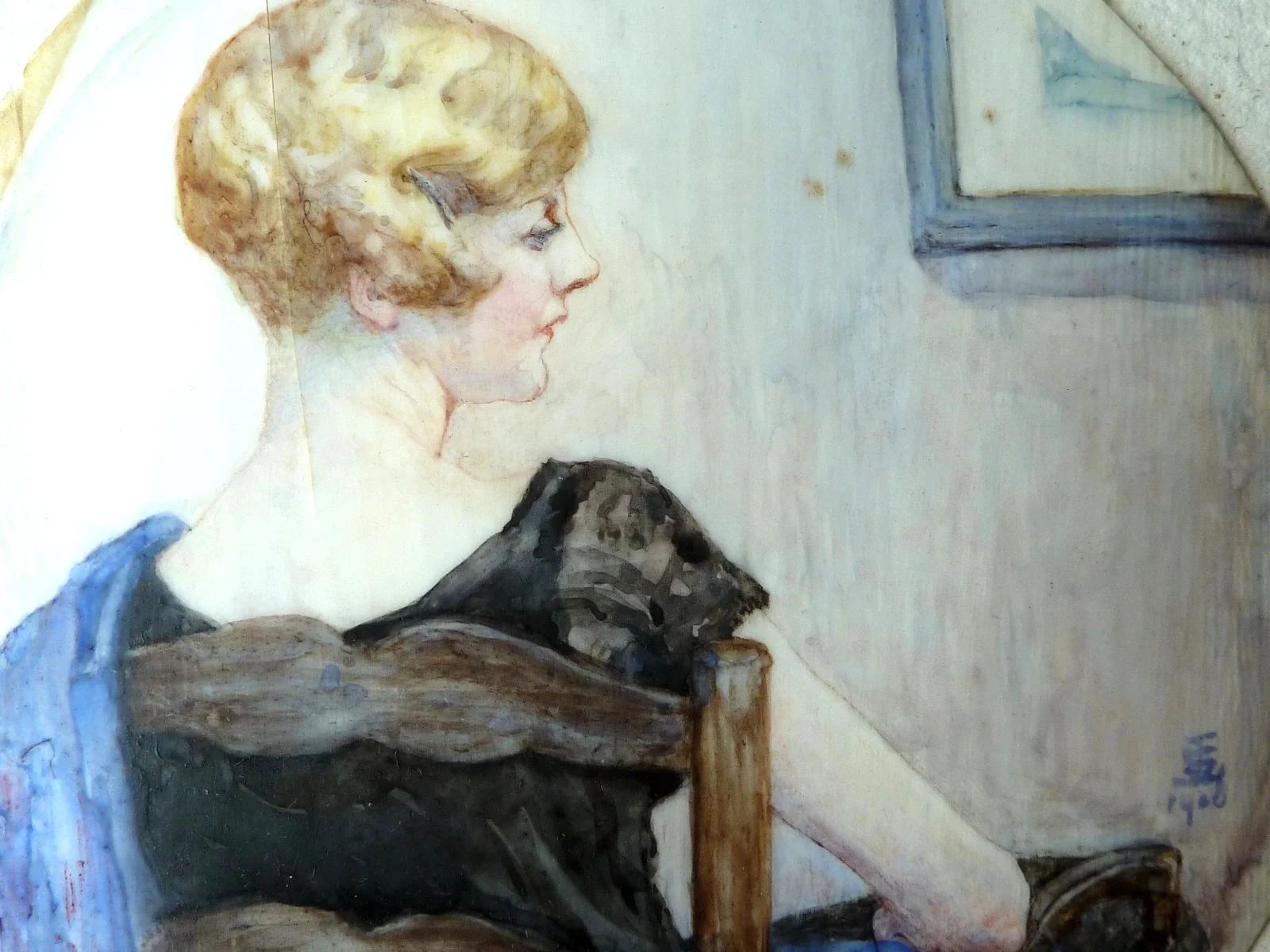


A seated lady with fashionably waved blonde hair turns away from the viewer in three-quarter profile, her posture framed by a dark dress and a rich blue wrap resting against a ladder-back chair. Executed in watercolour on a thin celluloid wafer, the portrait captures subtle interior light falling across the sitter’s nape and cheek against a pale, tonal interior wall. The composition bears the artist’s monogram signature alongside the date 1926 in the lower right corner.
The painting is fitted beneath original convex glass inside an individual hand-worked brass frame. Given Lassam’s dual training as a metalworker and painter, this circular mount was likely produced by her own hand, displaying hand-hammered texturing, linear border chasing, and incised geometric eye motifs along the bezel. Historical paper documentation on the reverse connects this piece to an exhibition at the Society of Women Artists, held at the Royal Institute Galleries on Piccadilly in London, recording the subject as Miss Grace Antiniou.
About the Artist:
Susie Lassam (1875–1962) was an accomplished British miniature painter, modeller and craftswoman. Born in Dulwich Village, south London, she was educated at James Allen’s Girls’ School before pursuing extensive artistic training at the Lambeth School of Art, the Royal College of Art, and the LCC Central School of Arts and Crafts. She lived for many years at Rose Cottage in Dulwich before establishing her home and studio at Galmpton near Brixham in South Devon. Lassam exhibited regularly with major institutions, showing at the Royal Academy between 1908 and 1936, the Paris Salon, the Walker Art Gallery in Liverpool, and the Royal Glasgow Institute. Her career was intimately connected to the Society of Women Artists, where she displayed over one hundred exhibits between 1915 and 1959, earning election as an associate in 1931 and a full member in 1940. She was also an associate member of the Royal Society of Miniature Painters and a member of the Society of Miniaturists.
The miniature panel has straight trimmed side edges, making the wafer slightly narrower than the circular brass frame aperture. A vertical hairline split traverses the celluloid panel through the figure’s neck and coiffure, neatly secured with vintage backing tape on the reverse so that it remains discreet when viewed from the front. Surviving in untouched, original condition, this piece provides an evocative example of British decorative art from the artist’s studio collection.
Condition Vertical hairline split running through the celluloid wafer across the hair and neck, secured with vintage tape on the reverse. The wafer sides are trimmed slightly narrow for the frame. Untouched condition with natural patina to the hammered brass frame.
| Period | 20th Century |
|---|---|
| Style | Interwar |
| Colour | Black, Blue, Cream, Gold |
| material | Brass, Celluloid, Glass |
| Origin | United Kingdom |
| Price range | Under £2000 |
| Collection Era | Antique & Vintage |
| Maker | Susie Lassam |
Only logged in customers who have purchased this product may leave a review.
Reviews
There are no reviews yet.